
When you purchase through links on our website, we may earn a commission. Affiliate disclosure.
Despite the overwhelming array of electric bikes on the market, the DIY option is still very popular amongst enthusiasts. The best ebike conversion kits allow you to customise a bike to suit your needs. The end user can fine-tune things like battery capacity, motor power, and pedal assist characteristics in providing the perfect biking experience!
What are the best bike conversion kits in 2023?
- Best newcomer for 2023: CYC Photon
- Best mid-drive e-bike kit: Bafang BBS02B 750w
- Best torque-sensing conversion kit: Tongsheng TSDZ2
- Best 1000w e-bike conversion kit: Bafang BBSHD
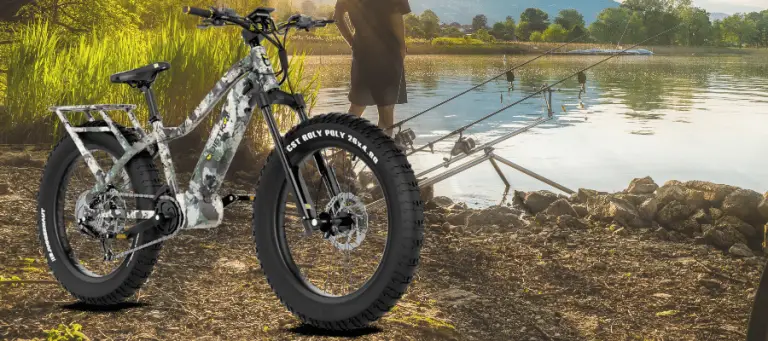
- Best fat bike conversion kit: EBikling
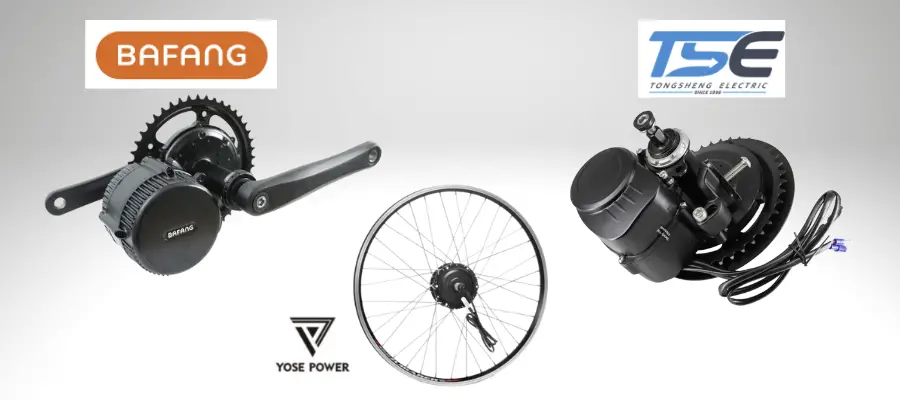
- Best rear wheel conversion kit: Bafang rear wheel hub motor
- Best budget conversion kit: Voilamart
- Best front wheel e-bike kit: Yose Power
Why do ebike conversion kits make sense? Because they are affordable and customisable. You can fit a more powerful motor if you live in a hilly area. Do you need an electric bike to tackle longer journeys? No problem, you can choose a bigger battery to suit your requirements.
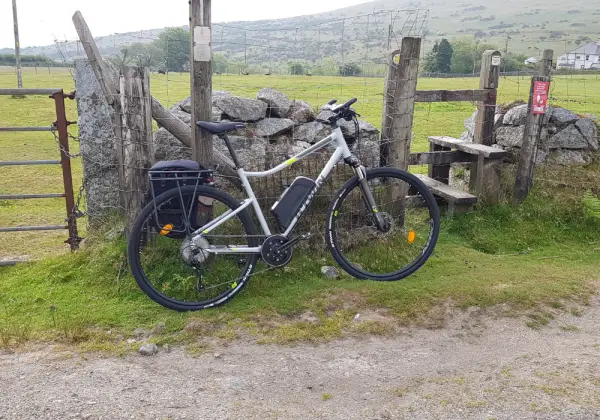
Without further ado, here are my recommendations for the best ebike conversion kits in 2023. I ran a successful electric bike conversion business for five years and have extensive knowledge and experience with most of the kits featured below. For more information, please read my electric bike conversion kit guide at the bottom of this article.
CYC Photon
Best New Electric Bike Conversion Kit for 2023
Specifications
- Motor location: Bottom Bracket
- Motor compatibility: 68 – 83mm Threaded, BB92 Pressfit, 100mm or 120mm threaded
- Motor weight: 3.3 kg
- Power output: 1200-watts max – can be configured to meet EU / UK 250-watts (continuous)
- Voltage: 36 – 52 volts
- Top speed: 30 mph (estimated) depends on gearing and other factors
- Price: $950 / £975
Pros
- Compatible with different bottom bracket types
- Lightweight
- Customisable
- Good chainline
Cons
- Expensive
- Increased wear on bike gear components and chain
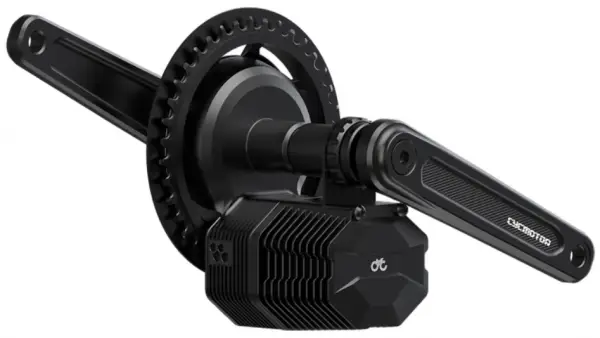
The new CYC Photon looks like the mid-drive ebike conversion kit we’ve all been waiting for! For the last couple of years, I’ve been saying that the ebike conversion world needs a bit of a shake-up. A lot of what’s on offer in 2023 hasn’t changed that much in nearly eight years.
Hong King-based CYC already shook things up with their X1 Pro motor, aimed at the high-performance end of the market. This latest offering from CYC looks like it fills the void between the Bafang BBSHD and X1 Pro. It’s lightweight, compatible with various bottom bracket sizes and has a torque-sensing assist. In addition, you can configure the motor parameters through the CYC Ride Control smartphone app. They have even designed the chainring to reduce offset and improve the chainline.
Bafang BBS02B 750w
Best Mid-Drive EBike Conversion Kit
Specifications
- Motor location: Bottom Bracket
- Motor compatibility: BSA 68mm – 73mm threaded bottom bracket shell
- Motor weight: 4.6 kg
- Power output: 750-watts (nominal) 1200-watts (peak power with 48v battery)
- Voltage: 48-volts
- Top speed: 28 mph (estimated) depends on gearing and other factors
- Price: $400 / £400 Varies depending on the supplier
Pros
- Very powerful
- Customisable
- Smooth and quiet
- It is fairly straightforward to install
Cons
- Poor chainline
- Only compatible with threaded bottom brackets
- Hit-and-miss reliability
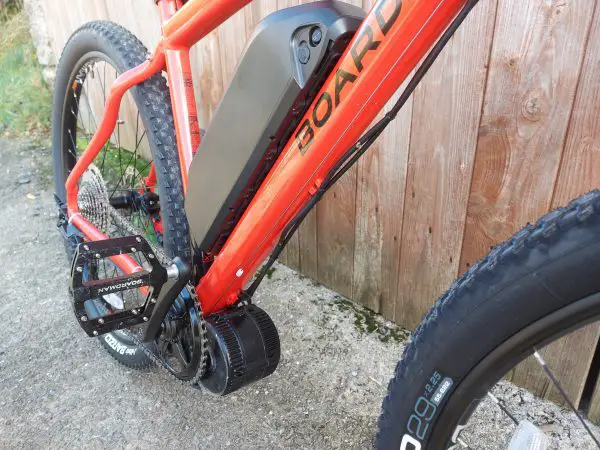
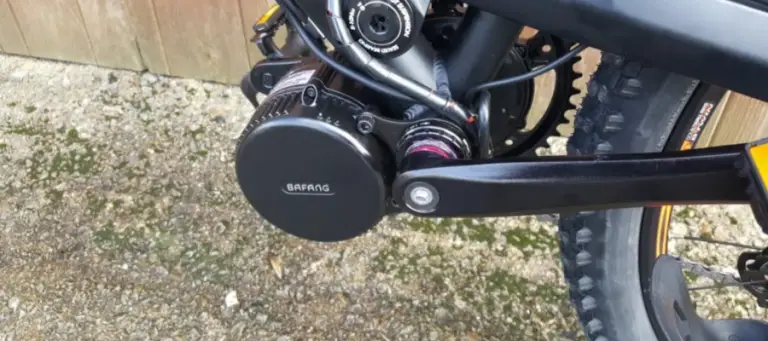
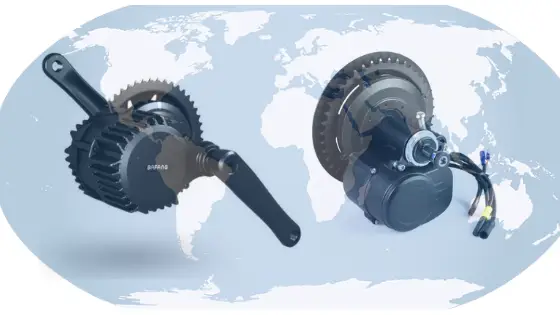
The Bafang BBS02B 750w has been around for a few years and has benefited from several upgrades. At its time of release in 2014, it was heralded as the best plug-and-play electric bike conversion kit on the market. Although early reliability issues plagued it, the BBS02B remains a global best-seller. I installed over one hundred of these motors over five years – in the first three years, I had a 10% failure rate (controller), but it seemed more reliable in subsequent years.
Riding a Bafang BBS02B-powered bike for the first time is memorable. It’s very powerful and will take you effortlessly up any hill. Installing the Bafang takes around 3 hours. I highly recommend the Bafang BBS02B 750w; it’s a great motor and easy to maintain, thanks to excellent parts availability.
Tongsheng TSDZ2
Best Torque-Sensing EBike Conversion Kit
Specifications
- Motor location: Bottom Bracket
- Motor compatibility: BSA 68mm – 73mm threaded bottom bracket shell
- Motor weight: 3.6 kg
- Power output: 250w – 500w (nominal)
- Voltage: 36-volts or 48-volts
- Top speed: 15 – 25 mph (estimated), depending on gearing and other factors
- Price: $350 / £300 The price varies between suppliers
Pros
- Torque-sensing pedal assist
- Lightweight
- Neat with minimal wiring
Cons
- Poor chainline
- Not as good for steep hills
- Some reliability issues
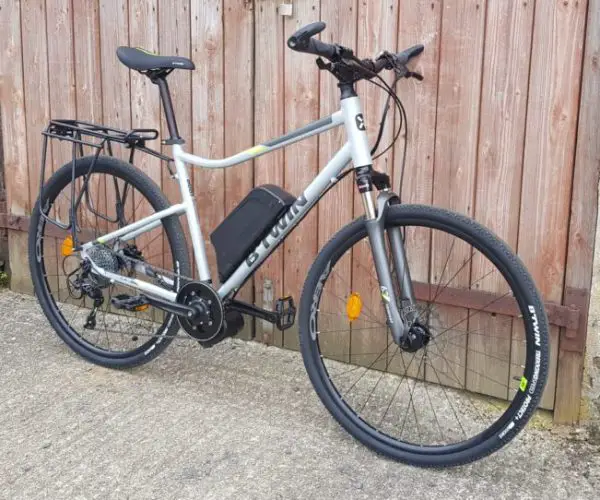
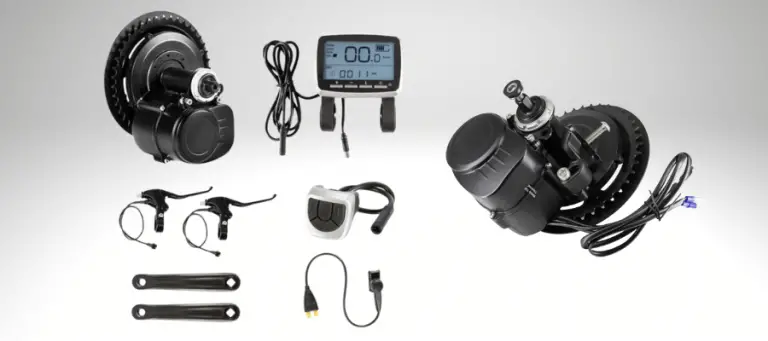
The Tongsheng TSDZ2 is a plug-and-play mid-drive ebike conversion kit. This system uses a sophisticated torque sensor for pedal assist, giving you power proportionate to the force applied to the pedals (much like the Bosch system). The benefits of this system are that it gives you an enhanced cycling experience rather than just giving you power whenever the pedals are turned. In other words, you still have to put some effort in. Also, it’s more efficient (than the Bafang).
I have installed nearly fifty of these motors with very few issues over the years. This is a popular motor for converting a recumbent due to its lower weight (when compared to the Bafang). The TSDZ2 was recently updated, and several weak points were addressed. I love Tongsheng. It is a cracking mid-drive motor for the money. This is the kit for you if you are after Bosch-like performance for a fraction of the price. For more info on fitting, check out the Tongsheng installation manual.
Bafang BBSHD
Best 1000w Mid-Drive Electric Bike Conversion Kit
Specifications
- Motor location: Bottom Bracket
- Motor compatibility: BSA 68mm – 73mm threaded bottom bracket shell
- Motor weight: 4.8 kg
- Power output: 1000w (Nominal) over 1500w (Peak)
- Voltage: 48 volts (52 volts Optional)
- Top speed: 28 mph – 35 mph (Depending on Gearing)
Pros
- Super smooth
- Great performance
- Robust and generally reliable
- Customisable
Cons
- Poor chainline
- Heavy
- Quite expensive
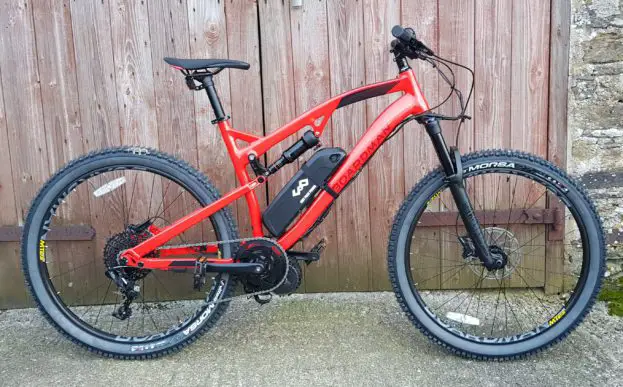
If you’re familiar with ebike conversion kits, you’ll know the Bafang BBSHD is popular. It’s been a go-to mid-drive motor for enthusiasts for the past seven years. While it may not seem much more powerful than the BBS02B on paper, you’ll feel the extra power when you ride it. It’s not the most powerful e-bike motor, but affordable for most people.
With a high-quality 52-volt battery, peak power will be nearly 1800 watts (with a fully charged battery). Even as the voltage drops off, power stays above 1200 watts. It climbs hills like a mountain goat, making your bike wheelie if geared low enough. No other conversion kit offers the same bang for your buck, value for money and relative ease of installation.
Ebikeling
Best EBike Conversion Kit for Fat Tyre Bike
Specifications
- Motor location: In front or rear wheel
- Motor compatibility: 135mm front or 175mm rear quick-release rear dropouts
- Motor weight: 15.8 lbs
- Power output: 1200 watts (1450-watts Peak)
- Voltage: 48 volts
- Top speed: 28 mph
Pros
- High quality
- Reliable
- Straightforward to install
- Good top speed
Cons
- Heavy and inefficient
- Not so good on steep hills
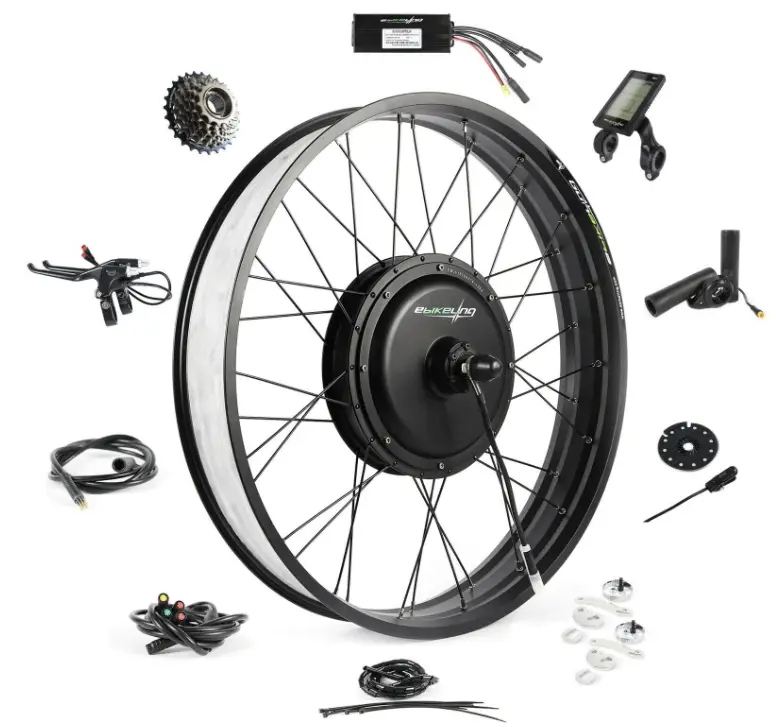
The Ebikeling 1200-watt fat tyre ebike conversion kit is a high-quality option available to customers in the US and Canada. They also ship to the UK and EU, but the shipping cost is high. It’s a popular choice with electric bike enthusiasts and provides a cost-effective way to convert your fat tire bike to electric. In addition, the Ebikeling kit is available in either front or rear wheel fitment, so you could potentially build yourself an all-wheel drive beast of a machine!
With a peak power of 1450 watts, there’s plenty of power for cruising on gravel tracks or taking your bike to the beach. These direct-drive hub motors are very smooth and practically silent. The only downside is they’re not particularly efficient so that you will need a good battery with a large energy capacity.
This kit includes everything you need (apart from the battery) to get going. And there’s good customer support and warranty backup from a US-based company. It is worth considering if you want to boost your fat bike performance.
Bafang Rear Wheel Conversion Kit
Best Rear Hub Motor Conversion Kit
Specifications
- Motor location: In front or rear wheel
- Motor compatibility: 135mm front or 175mm rear quick-release rear dropouts
- Motor weight: 4 lbs
- Power output: 500w
- Voltage: 36v or 48v
- Top speed: 15 – 25 mph
- Price: $300 / £300 The price varies between supplier
Pros
- Very smooth performance
- Reliable
- High torque output
Cons
- Not legal in the UK and EU
- Lots of wiring to tidy
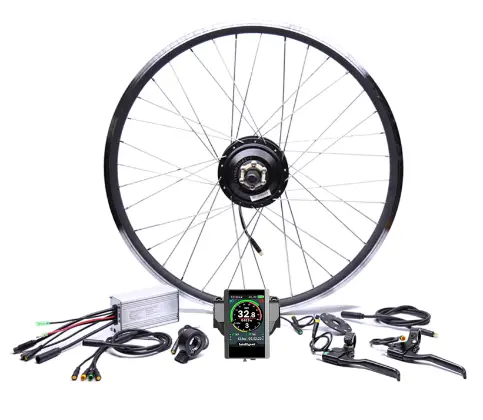
Bafang has been a global leader in electric bike components for years, and its geared hub motors are among the best available. They are so good that many electric bike manufacturers use their hub motors in factory electric bikes. The Bafang hub motor is generally very reliable while at the same time offering top-class performance. The motor is a little noisier due to the planetary gears, but the noise is minimal.
The other great thing about the Bafang hub motor is its durability. Geared hub motors can sometimes suffer from the wear of the planetary gears (usually made of nylon), but with the Bafang hub motor, it doesn’t seem too much of a problem. As with all hub motors, you must regularly check and tighten the spokes and ensure you fit an excellent puncture-resistant tyre like a Schwalbe Marathon Plus – to save on time-consuming roadside puncture repairs.
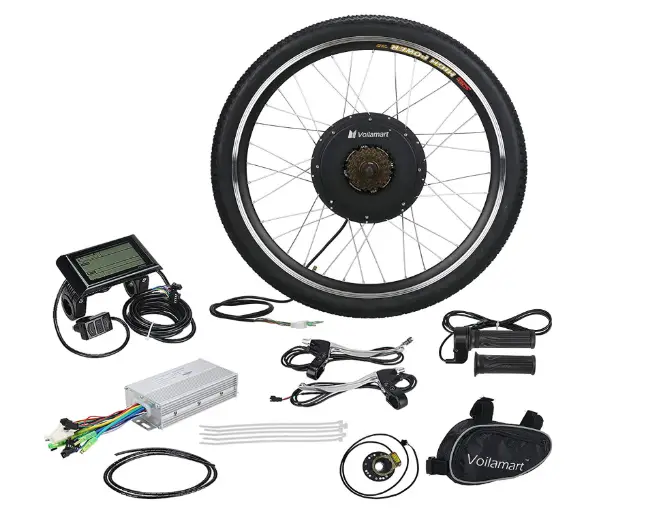
Voilamart
Best Budget E-Bike Conversion Kit
Specifications
- Motor location: In front or rear wheel
- Motor compatibility: 135mm quick-release rear dropouts or 100 mm on the front
- Motor weight: 8 kg
- Power output: 1000w (1200w peak power)
- Voltage: 48v
- Top speed: 25 mph – 30 mph
- Price: $220 / £220 The price varies between supplier
Pros
- Very cheap
- A lot of power for the price
- Reliable
Cons
- Very heavy
- Inefficient
- Not road legal in the UK and EU
The Voilamart 1000w rear wheel direct drive e-bike conversion kit offers exceptional value for money. In fact, out of all the kits reviewed in this article, this one offers the best bang for your buck! It’s usually available in 26″, 28″ and 26″ wheel sizes.
I have installed loads of these over the years, and they are surprisingly reliable, considering the bargain price. These direct-drive hub motors are generally very robust and reliable. They may not be particularly efficient, but this motor will give you enough power to comfortably ride at 25 – 30mph on the flat. It’s worth considering if you are after something a bit faster.
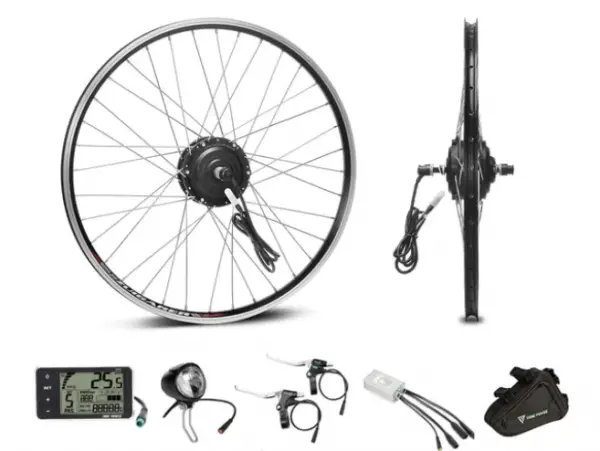
Yose Power Front Wheel Motor Kit
Best Front Wheel E-Bike Conversion Kit
Specifications
- Motor location: Front wheel
- Motor compatibility: 100mm
- Motor weight: quick-release dropouts
- Power output: 250w
- Voltage: 36v
- Top speed: 15.5 mph / 25 km/h
Pros
- Excellent value for money
- Easy installation
- Tools included
- Nice display
- Road legal in the UK and EU
Cons
- Noisy under load
- It adds a lot of weight to the front
- Not suitable for steep technical off-road climbs
👇Use Discount Code: BH2E24BXQH for a €10 discount (Yose Power Direct)
During my time converting e-bikes, the Yose Power e-bike conversion kit was among the most popular. If you’re looking for one of the easiest ways to electrify your bike, a front hub motor is simple to fit. I used to deal with Yose Power directly and always found them to be very helpful. Plus, their motor kits come with a tool kit, cable ties, and instructions.
Performance is quite good for moderate hills and rolling terrain, and because these motors are quite small, they don’t add too much weight to your bike. In addition, the 250-watt version is road-legal in the UK and EU. For the price, they’re probably one of the best e-bike conversion kits going and well worth considering if you want a quick and easy way to convert your bike to electric.
EBike conversion kits (a quick guide)
Several important factors must be considered when searching for the best electric bike conversion kit. I have outlined some important considerations below to help you make the best choice for your needs.
E-bike laws: This is the first and most important consideration. E-bike laws vary from country to country. For example, US federal law allows for 750 watts and up to 28 mph for a class 3 e-bike. UK e-bike laws are much stricter – you are limited to 250 watts and 15.5 mph. Building a non-compliant e-bike and using it on public roads could land you in hot water. Plus, you may get your pride and joy confiscated.
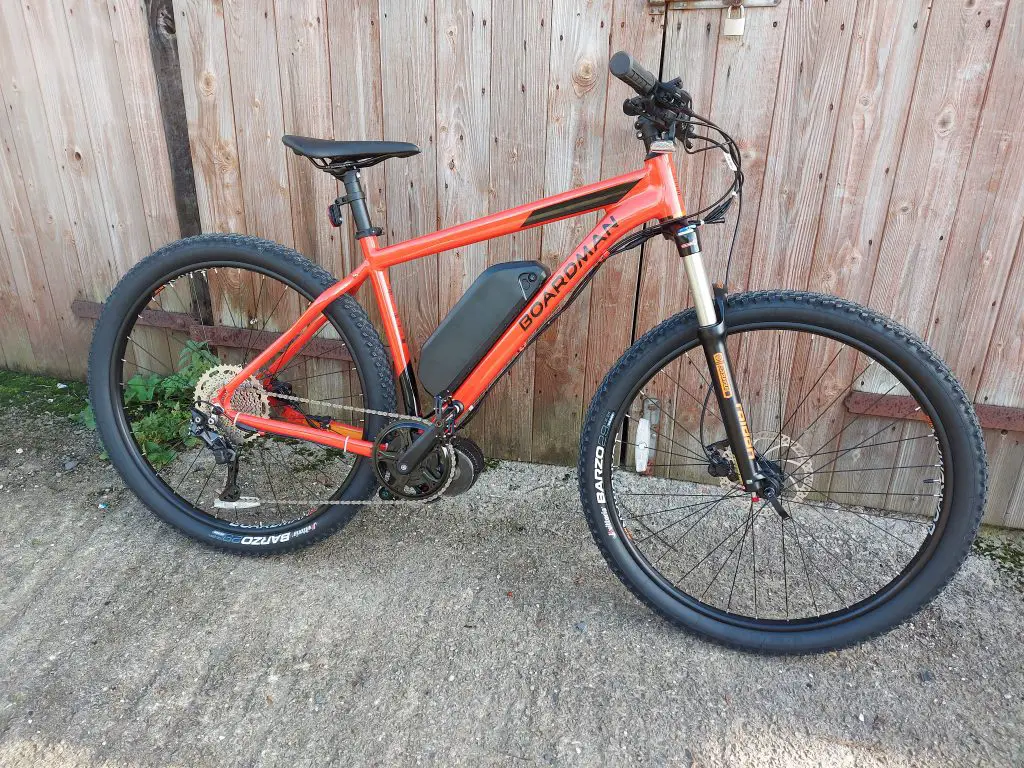
Power output: The motor power is measured in watts and typically ranges from 250-1500 watts. A higher-wattage motor will provide more assistance but require a larger battery and may be more expensive. It’s also worth remembering that higher wattage doesn’t always translate to better performance. The type of motor and the way it delivers the power is important. You can have a 250-watt mid-drive motor, outperforming a 750-watt hub motor on hills.
Check out the top 20 electric bike FAQs
Battery capacity: The battery is the power source for the e-bike and is measured in voltage and amp hours (Ah). A larger battery will provide a longer range and add weight to the bike. Battery choice is one of the most important things to consider when buying a conversion kit. Buy cheap, and you may not get the best out of your motor. Plus, longevity may be greatly diminished. The type of lithium cells used and how the battery is assembled will all affect performance. So, for that reason, I recommend getting a battery that uses either Samsung, LG, Sanyo, or Panasonic cells.
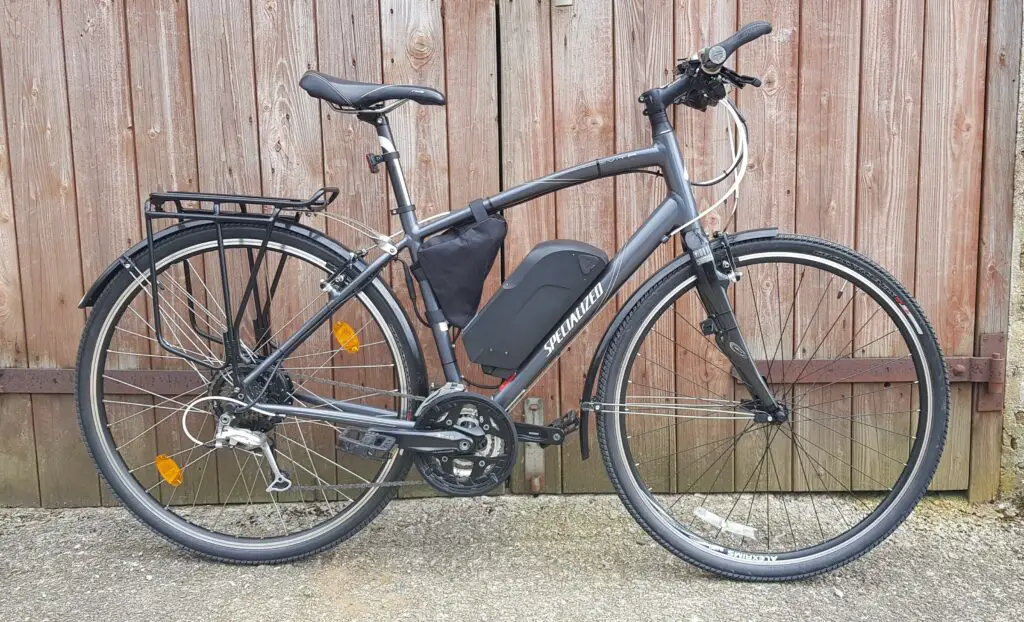
Compatibility: If you’re buying a hub motor, choose a conversion kit compatible with your current bike’s wheel size – this can usually be found on the tyre’s side wall. In addition, most hub motor kits are for quick-release dropouts – some modern bikes have thru-axle frames, which would not be suitable for these motors. For a mid-drive motor, there are different things to consider – the main being your bicycle’s bottom bracket size. Most mid-drive motors fit a standard BSA threaded bottom bracket of 68 mm-73 mm with an internal diameter of 33.5mm.
Speed: This also relates to legality. Most e-bike conversion kits come with an LCD, allowing you to limit your bike’s top speed. This can be useful for riders who want to stay on the right side of the law, maximise battery range or use their e-bike for commuting or recreation, and not for high-speed riding.
Types of ebike motor
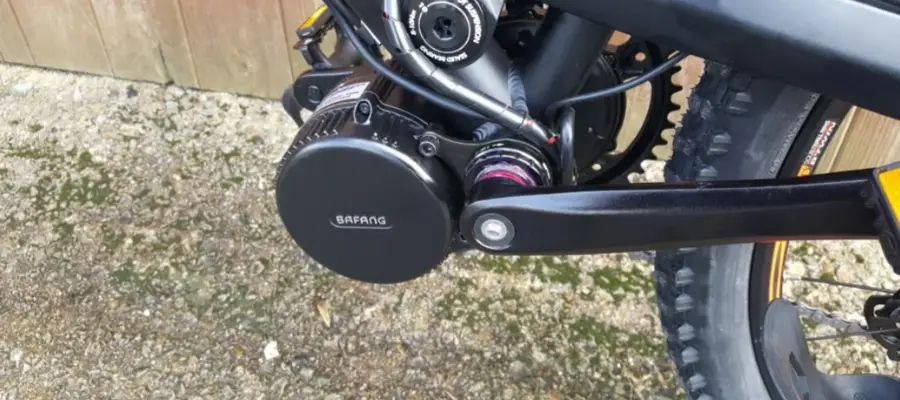
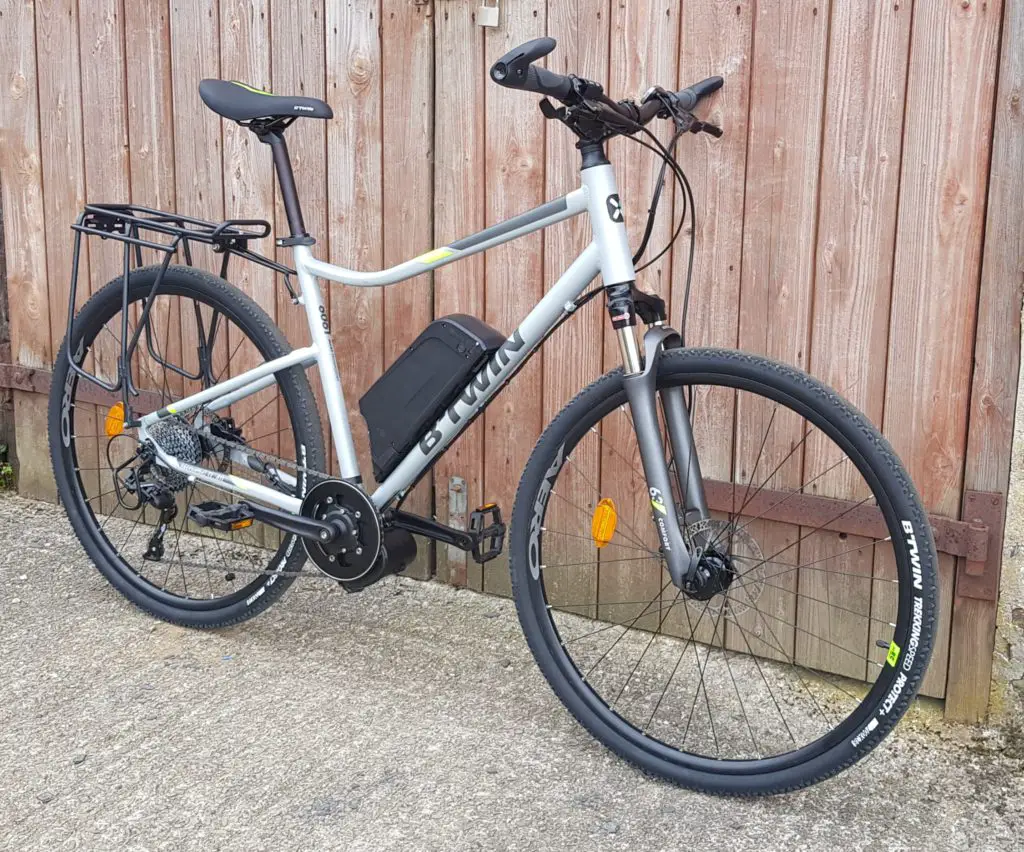
Mid-drive motor: A mid-drive or crank-drive motor is fitted in place of the bicycle’s bottom bracket – this component connects the crankset to the bike and allows the crank to rotate freely. The main benefit of this type of motor is it places the extra weight centrally and low down. This can improve stability and handling and make the bike feel more ‘planted’. Other benefits include performance and efficiency. Because a mid-drive utilises the bike’s drivetrain to transfer power to the back wheel (like on a motorcycle), you get better torque and much stronger hill-climbing ability. This is my favourite kind of e-bike motor.
Hub motor: These are the cheapest and most common types of conversion kits. Electric hub motors have been around for over 100 years, and modern direct-drive motors are that far removed. They are heavy and inefficient. But, they offer substantial performance gains for not a lot of money. Geared hub motors are more recent. And, as the name suggests, these motors have a planetary gear system which allows the motor to spin faster than the wheel. They produce more torque and are much better at hill climbing. Plus, they are much lighter and more energy efficient (than direct drives).
Friction drive motor: These motors have also been around for a while and are an easy way to boost your pedal power. These are usually fully integrated units with relatively low battery ranges. A small motor drives a rubberised roller. Which, in turn, makes contact with the tire and assists. Recently, motors like the Rubee X featured above have taken this old technology and added a modern twist. A single unit you can fit onto most bikes and quickly remove when not in use. It is ideal for the commuter or rider looking for a boost occasionally. But it’s not really practical for longer-distance riding.
Find out more about the pros and cons of hub motors vs. mid-drives
E-Bike conversion kit pros and cons
Pros
- Customisation: You can choose a kit that fits your needs and preferences. If you live in a very hilly area, you can specify a high-torque mid-drive with plenty of hill-climbing power. Or, if you live in a flat area, maybe a big hub motor for effortless cruising. In addition, you can get the right battery for your requirements. If you only ride short distances, a small battery will suffice. If it’s weekend adventures off-the-beaten-track, then a big, high-capacity battery is what you need.
- Using a bike you already own: Still got that classic ’90s mountain bike languishing in your shed or garage? Why not give it a good clean-up, service, and fit conversion kit? It will completely transform it and motivate you to get out and ride. Hills and headwinds needn’t be a problem anymore!
- Cost: Generally speaking, converting a bike you own to an electric one will be significantly cheaper. With most mid-drive electric bikes starting at over $1500 / £1500, you can build one for a fraction of that price.
Cons
- Compatibility issues: You’ve taken measurements and double-checked everything, only to find that installing your kit’s not going well. Unfortunately, this does happen, and even after five years in the trade, I still came unstuck occasionally. No two bikes are the same, and most e-bike kits are generic. As long as you research beforehand, you will limit this risk.
- Excessive wiring: If you want your project to look like a factory-produced e-bike, you must deal with all the excessive wiring that usually comes with these kits. It took me a little practice, and you’d be surprised how good the finished article can be. But, if you slap everything on and don’t tidy anything up, your bike will have a ‘DIY look’.
- Reliability: In my experience, most e-bike conversion kits are fairly reliable. But, problems do seem more common with conversion kits when compared with factory-produced electric bikes.
Conclusion
Converting a bike you own to an electric can be fun, but it can also be challenging. You will need a good workspace, preferably a bike stand, to make things easier. Having the right tools beforehand will also help. If you’re not confident in your ability to do the job yourself, then I would ask a friend to help or even use the services of your local bike shop. Some shops won’t touch e-bike conversion kits, but others will gladly help.
The best ebike conversion kits offer a cost-effective and customisable way to enjoy the benefits of an electric bike. When choosing your conversion kit, remember the compatibility, installation, weight, laws and regulations, and maintenance. With the right conversion kit and a little bit of effort, you can give your old bike a makeover and start to enjoy riding again.
Thanks for reading. If in doubt, please feel free to leave a message in the comments section below, and I’ll get back to you within 24 hours. Thanks for reading!

Hi tony,
I drive a Voilamart 1000w with 48V. I’ve already driven 3000km with it and never had any problems except with the police. The Voilamart is cheap and powerful, but has no pedal power assistance. In the PAS, the device either gives full throttle or nothing.
In Germany you can probably only have a maximum power of 600W and a nominal continuous power of 250W. The Voilamart cannot be throttled, it sometimes starts with 1100W.
You can limit it to 25kmh but that doesn’t change the Power.
The setting to 1 amp does not change anything either.
Now I’m looking for something that is legally drivable on the street (pedal force sensor, power throttle (250W/max600W), speed <26kmh) and can be unlocked off-road to let the pig out.
Can you recommend something to me?
With kind regards
Axel
Hi Axel,
The Tongsheng TSDZ2 should be suitable for your needs as it uses a torque sensor (measures pedalling force) and will take a 48v battery. The 500w version is indistinguishable from the 250w version and there is no identifying labels on the motor to say it’s 500w. You can limit the speed easily through the display to 25km/h and pedal assist is very smooth and reacts to your pedalling input very nicely. The only problem with the TSDZ2 is it can need periodic maintenance – the blue gear inside the motor can fail, but it is quite easy to replace if you have some basic tools. The TSDZ2 is also very efficient when compared with a direct-drive hub motor and you will see a significant increase in battery range. Here is a link to the Tongsheng TSDZ2 motor kit in Germany.
All the best,
Tony
Hi Tony
Your site is really helpful not to mention the comment section.
I have a Scott sportster P2 from 2010 that i thinking of do a conversion on. When I read the specification on the bike I found that the bottom bracket is 68mm. Do you have chose the BB size when you order a Bafang 1000w kit? or is it universal?
Kind regards
Per
Sweden
Hi Per,
You will need the 68mm-73mm BB version as there is also a 100mm and 120mm version for fat bikes.
Regards,
Tony
Please help!! I have a 2021 Salsa Mukluk Deore 11 speed I want to convert to an ebike. The BB is 100mm and I have a 30 tooth single front chain ring. I am worried about the size of the chain ring and the clearance of the bb to the chain stay. It really kicks out and the 30 tooth chain ring has minimal clearance. I am reading about using a 120mm mid drive system instead of a 100 mm mid drive system (bafang). Do you have any experience with the 2021 Mukluk? Which system should I use? Is a rear hub drive better? Hope you can provide some guidance .
Hi Steve,
I have successfully converted a Salsa Mukluk before using a 120mm Bafang BBSHD and spacers. Unfortunately I did the conversion for a customer and no longer have all the photos, but there is a photo of the build here. I used a 36t Lekkie Bling ring with this conversion and also needed to get a slightly longer chain.
Let me know if you need any more info.
Cheers,
Tony
Thanks for your reply. The wheels on this 2021 bike are 26×4.6 and the chain stays are pretty far apart and there is a steep angle coming off the BB. Not sure if the differences between 2021 and earlier models. The single front chain ring is 5” and is about 1.5cm away from the chain stay. Do you recall any extraordinary steps you had to take to make the mid drive fit without hitting the chain stay and maintain a useful chain line? Did you use an offset chain ring?
Hi Steve,
I received your email with photos and I’ve sent a copy of this reply to your email address
I remember with the older Mukluk I converted we used the 120mm BB version of the BBSHD with loads of spacers and even then, it was a close call. I think there was also an issue with the non-drive crank arm slightly touching the chain stay (we used a different crank arm in the end). The q-factor was much wider as a result.
The chain line offset was quite a bit outboard – it was fine in the higher gears but when you shifted to the 2-3 lowest gears it wasn’t ideal. We mitigated the issue with a 36t Lekkie Bling ring which brought it in by about 10mm but it was far from perfect and still cogged a lot in the lower gears. I think we used the SRAM X1 11-speed chain with 118 links.
Looking at your version it looks like the chain stay is at an even greater angle. I reckon you might be best sticking with a rear wheel hub motor conversion. I’ve just checked the specs of the 2021 Mukluk and they use ‘Alternator Dropouts V1.0’ which according to the website mean you can use QR or thru-axle.
I have looked at some of the rear hub kits available and they all use 9/10 speed freehubs so you should be okay with a 11-speed MTB cassette as the spacing is the same (road 11-speed cassettes need a wider freehub).
Let me know if you need any more help.
Cheers,
Tony
Hi Tony –
Greatly appreciate your informative site!
I have an ’09 or ’10 Gary Fisher Kaitia (mountain/commuter hybrid) that I’d like to use more frequently for a 20 mile round trip commute to work. I like the idea of a geared hub (for pedaling when the motor isn’t on) and leaning toward the Bafang 500w 48v Rear Wheel conversion kit per your review. The Kaitai has a quick release rear wheel with disc brakes and a freewheel gearshift (I believe). Does the Bafang kit make sense? This is going to expose my ignorance, but the quick release is not a thru-axle that makes the Bafang incompatible, right? I was also wondering if it desirable/possible to use a cassette gearshift or stay with the freewheel?
Thanks for your help
Doug
Hi Doug,
The 500w Bafang will be fine for your bike. The Bafang axle is compatible with quick-release dropouts. If you have 6 or 7 cogs on the back, then you have a screw-on freewheel. If you have 8-11 cogs then it will be a cassette freehub – most suppliers offer both options.
I hope this helps, let me know if you have any more questions.
All the best,
Tony
Hallo Tony,
ich finde diese Seite klasse.
Meine Frage:
Gibt es einen Mittelmotornachrüstsatz, der einen Getriebefreilauf hat ähnlich dem neuen Boschmotor Performance Line CX Gen4?
Mit bestem Dank im voraus.
Lothar
Hallo Lothar,
Leider ist derzeit nichts in der Nähe des Bosch CX erhältlich. Der Tongsheng TSDZ2 verwendet einen Drehmomentsensor, ist aber nicht annähernd so raffiniert oder zuverlässig wie der Bosch-Motor.
Grüße,
Tony
Hi Tony I have a yose power conversion kit fitted for a couple of years ,the last week, loss of assistance intermittent ,when i turn the pedals the pickup light is on but no power to back wheel ,i have fitted a new pick up lead and sensor disc ,but still the same the light is on but no power to rear wheel ,i have another e bike and i have connected the lead to rear wheel no power to that rear wheel is it the controler ? Lawrence
Hi Lawrence,
Yes, it sounds like the controller to me. You should be able to get a replacement from the Yose Power website. The other thing it could be is the wiring loom, these can sometimes break down over time.
Regards,
Tony
Ciao Tony, ho una e-bike dell’ Adriatica 250 watt motore centrale, ma vorrei maggiore potenza specialmente in salita. Cosa mi consigli di fare? Grazie
Ciao,
Sapreste dirmi che modello è o che motore monta? Se è un mid-drive Bafang, allora ci sono opzioni. Se è Shimano Steps, puoi modificare il limite di velocità tramite un’app, ma invalida la garanzia.
Salut merci pour tout ses conseils, bravo pour le site.
J’aimerais bien choisir entre deux type de moteurs: Bafang BBS ou Tongsheng 250W moyeux de pédalier
ou le Bafang roue arrière de 250 W.
Mon projet est: – un trajet quotidien de 20 km allé-retour avec plusieurs pente dont une de 13%…
– équiper un mini vélo cargo ( type omnium mini) pour porter max 100kg avec la personne.
– avoir besoin de l’assistance seulement dans les forte monter ou très chargé. Je suis assez sportif.
– être légal sur la route dans L’UE.
Le Bafang 250W Roue Arrière sera-t-il assez puissant avec ses 32Nm?
Si oui cela semble la meilleur option.
Sinon sera-t-il possible de rouler en utilisant au minimum l’assistance électrique avec le Bafang BBS ou Tongsheng 250W à moyen de pédalier.
Et si oui lequel des deux est le mieux pour cela?
Est qu’il est facile de trouver des pièces de rechanges et un plateau de 36 dents pour le Tongsheng.
Un grand merci!
Ciao grazie per tutti i suoi consigli, congratulazioni per il sito.
Vorrei scegliere tra due tipi di motori: mozzi movimento centrale Bafang BBS o Tongsheng 250W
o la ruota posteriore Bafang 250W.
Il mio progetto è: – una gita giornaliera di 20 km andata e ritorno con diverse pendenze di cui una del 13%…
– equipaggiare una mini cargo bike (tipo mini omnium) per trasportare max 100kg con la persona.
– necessitano di assistenza solo su salite ripide o carichi pesanti. Sono abbastanza atletico.
– essere legale su strada nell’UE.
La ruota posteriore Bafang 250W sarà abbastanza potente con i suoi 32Nm?
Se è così, sembra l’opzione migliore.
Altrimenti sarà possibile pedalare utilizzando almeno l’assistenza elettrica con il Bafang BBS o il Tongsheng 250W con guarnitura media.
E se sì quale dei due è meglio per questo?
È facile trovare pezzi di ricambio e una corona da 36 denti per il Tongsheng.
Un grande grazie!
Sì, il motore del mozzo Bafang dovrebbe andare bene per pendenze fino al 15%. La mia attuale e-bike utilizza un motore del mozzo Bafang 250w. E sono riuscito a salire fino al 25%, anche se avevo bisogno di aggiungere molto del mio sforzo di pedalata. L’importante è avere la marcia giusta. Sarebbe preferibile una corona da 36 – 38 denti, con cassetta 11-40 o 11-42.
Saluti,
Tony
Dear Tony
You’re becoming my new guru of bicycles.I’m looking to convert my hardtail Cannondale Trail 5,29″ in an electric one.Because I’m getting old(55) and is difficult to climb the hills.I wish a kit to assist me on climbing the slopes ,On the flat roads is fine.No need speed,just assist,I’m wheigh 88kg.Usually I’m riding around 80km in weekends.I wish something reliabile and which doesn’t bother to much.You’re answer will be very much appreciated!Thank you
Following your kind advices I decided to go with Tongsheng.Just one question I still have:
which battery is best value for money for use with motor 48V500W?Plz provide 2options.I found this link(from you) which is sending in Romania full kit from UE store:
https://www.aliexpress.com/item/1005004942947590.html?spm=a2g0o.productlist.main.1.26f524deouS09X&algo_pvid=61a8074d-19d0-4f78-aaee-fa543ccbfdc5&algo_exp_id=61a8074d-19d0-4f78-aaee-fa543ccbfdc5-0&pdp_ext_f=%7B%22sku_id%22%3A%2212000031106125575%22%7D&pdp_npi=2%40dis%21EUR%21327.78%21285.17%21%21%21%21%21%402145274c16753215525734586d06ca%2112000031106125575%21sea&curPageLogUid=3hGhOqu3vGkx
Thank you Tony for all your precious suggestions
Hi Cristian,
Here is a link to a supplier I have used many times before. Their batteries are good quality (I’ve never had issues): 48v 15Ah battery ships from Germany Use Discount Code: BH2E24BXQH for a €10 discount.
Kind regards,
Tony
Thank you so much!
You’re welcome. Let me know how it goes👍
Hi Cristian,
If it was me, I would try out the latest Tongsheng TSDZ2 ‘B’ version. Apparently, a lot of the early problems have been sorted. Because this is a new model, there’s not a lot of long-term info on reliability. For a safe bet, I would go for the Yose Power Kit – these are generally very reliable. The only issues I here from owners are the occasional broken spoke. For your Cannondale MTB, you would need the 28″ rear wheel version with a cassette freehub. The Yose Power is easy to pedal without assist (feels like a normal bike), but offers a good turn of speed on hills up to about 15% gradient. I’ve checked the spec on your bike and it should be compatible.
If you have any more questions, let me know.
Cheers,
Tony
Thank you very much!
You’re welcome!
I’m becoming crazy!Just find that to climb the hills I need ad least 500W,with presion pedal sensor which just a mid drive motor can supply.So now I rather opt for the Tongsheng.Should I carry on a chain with me?I’m use the right ratio when climbing but…Help!
Hi Christian,
I covered nearly 1000 miles on a Tongsheng bike and never had any issues with the chain. As long as you use a good quality chain like Shimano or KMC, you shouldn’t have any issues.
Thank you and best regards
Dear Tony,
After doing a little research about the 2types of motors(your sugesstions were brilliant),I found that both have positives and negatiant-ves.The mid drive Tongsheng is light and potent but it stressed much the chain,and if something go wrong-you have to carry on the bike.On the other hand the hub motors even heavier and weaker-are more reliabile.And if some problems succeed during stroll,you will be able to pedal home.Furthermore-back or front hub?I’d say front because the bicycle will be more ballanced and the weigh is even.But I m affraid that my fork rake(2inches) will not allowed me to install the motor.So it seems that a gearless rear hub drive motor with casette should be my choice.I have to buy a brake sensor because the brake levers are not compatibile with my hydraulic brakes(Shimano M315). And I’m a little stressed because of rims diameter.
The bike is 29″ wheels,but there is just 28″ option or 700CC(what is that?) for rear hub motor.
I measured the rim-the inner diameter is 60cm and outter diameter is 62cm.The gums are WTB Ranger 2.25″.Is that 28″ fitted?
Thanks again for sharing your competent oppinion!
Hi Cristian,
A 29″ refers to the tyre outer diameter. The inner is 28″, so a 28″ / 700c rim would be the right one. Ideally you’d want the internal width of the rim to be at least 19mm, which I think the Yose Power wheels are. I don’t usually fit the brake sensors, unless throttle is being used. You can buy the sensors for hydraulic brakes if required.
Regards,
Tony