

When you purchase through links on our website, we may earn a commission. Affiliate disclosure.
In this Bafang hub motor review, I look at this high-performing and reliable electric bike hub motor. It’s relatively cheap while offering a significant boost in performance for day-to-day riding. This makes it a popular choice among DIY e-bike builders and manufacturers. In this article, I will examine its features, benefits, and drawbacks based on six years of experience with this motor. Find out more about my electric bike conversion service.
Since this article was posted four years ago, Bafang has been very busy! Their hub motors are now found on nearly 70 well-known brands and many lesser-known brands. In addition, the Bafang hub motor range now includes 12 rear motors and three front hub motors covering multiple uses from electric cargo bikes, city bikes and fat tyre e-bike applications.
Key features
- Various power options are available from 250w – 1000w
- Fitment for standard or fat bike wheels
- Supports torque-sensing controller and bottom bracket
- Available in 36v or 48v (will handle up to 52v)
- Available in kit form or as OEM motor on factory e-bikes
- Price: From £250 to £450 depending on the supplier ($300 – $500 approx)
Pros and cons of the Bafang hub motor
Pros
- High torque and efficiency: The Bafang uses a brushless motor with planetary gears. Small geared hub motors produce more torque than direct-drive motors, making them better for climbing hills. They are also much easier to pedal with the power switched off, making them much more suitable for someone who only needs the assist on hills.
- Ease of installation: If you’re fitting the Bafang as part of an e-bike conversion kit, it’s relatively easy to install. The motor kits usually come with all the necessary hardware and instructions, making it a straightforward process even for those without much mechanical experience. Additionally, the motors are available in various wheel sizes, so you should be able to find the right one for your bike.
- Cassette and freewheel gear options: There are two options for gearing – one will take the old-style screw-on freewheel (usually 6 or 7-speed), and the other will take a mountain bike cassette of 8 to 11-speed. The cassette version will not take a road 11-speed (like Shimano 105), as spacing is different and requires a slightly wider freehub.

Cons
- Weight: While the Bafang hub motor has many benefits, it has some drawbacks. One of the biggest drawbacks is weight. Although it’s now much lighter than previous incarnations, it still comes in at nearly 3 kg at the lower end.
- Not compatible with modern thru-axles: Another drawback of the Bafang hub motor is it’s only currently available for quick-release dropouts. With an increasing amount of new mountain bikes using thru-axles and boost rear hub spacing. If they want to stay ahead of the game, Bafang must offer this option for DIY e-bike builders.
- Premature motor wear: Reliability is generally good, but as with all electric motors, there can be problems from time to time. I have personally experienced hall sensor failure and premature wear of the nylon planetary gear. If you did experience problems down the line, parts are readily available, and the motor is easy to service for a competent DIY enthusiast.

Motor performance: 250w variant
I’ve owned several e-bikes with this motor. Indeed, my latest electric bike uses a 250w Bafang motor. In my experience, Bafang hub motors offer solid performance, from the 250w version right through to the 750w version.
The 250w Bafang hub motor is usually used in conjunction with a 36-volt 15-amp controller. This will give a peak power output (under load) of 540 watts. Peak output will depend on other firmware settings specific to the controller used. In addition, if a 48-volt controller is used, then peak power will be substantially more. I’ve ridden a road-legal e-bike with 48v Bafang 250w, and peak power was showing (on the display) at over 700 watts.
It seems the continuous motor rating (250w) is important for legality, but higher power outputs when under load are acceptable. The Bosch CX motor produces a peak power of around 600 watts.
Bafang offers a torque-sensing option – for OEM only, and unfortunately, not in conversion kits. The new Eskute Polluno Plus has this configuration, and it works well. The torque-sensor unit is housed inside a Bafang-branded bottom bracket. This system works incredibly well – it provides instantaneous electric assist the second you start to pedal. The torque sensor measures the pedalling force and adjusts the motor output accordingly. This drastically improves efficiency and riding experience.
Find out more about the pros and cons of a hub motor vs a mid-drive motor.

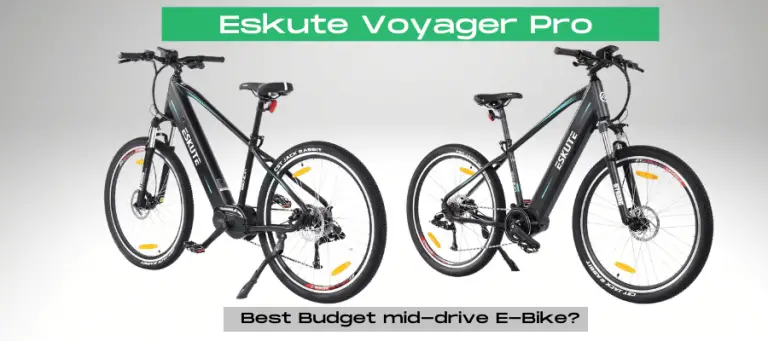
The other option is a cadence sensor – this is found on budget factory electric bikes like the Eskute Voyager, and Bafang e-bike conversion kits. The newer cadence sensor is an enclosed unit that slots into the splines on the bottom bracket. This kind of pedal assist has a much more on / off feel to it – you can ghost pedal (spinning the pedals without effort in a low gear), and you’ll still get assist. Controller firmware is usually programmed so that when a higher cadence is reached, the motor current is dialled back.

A 250w Bafang hub motor has enough power to comfortably get you up a 10% climb. But, steeper hills will require additional effort from the rider. The gearing on the bike will also be a contributing factor when negotiating steep hills – lower gearing = easier hill climbing.
For a 250-watt hub motor, the Bafang performs very well and will provide enough pedal assistance for most riders. Its limitations are only noticeable on very steep hills, but for moderate hills, it does the job.
Motor performance: 750w variant
The 750-watt Bafang hub motor tested here was fitted to a Cyrusher XF800 fat tyre e-bike. This motor is used in conjunction with a 48-volt 25-amp controller, giving a peak power of 1200 watts. When the battery is fully charged @54.4-volts, peak power will top out at 1360 watts.
Considering the heavy weight of this electric bike (32 kg), the performance of the motor is impressive. The cadence pedal assist sensor delivers a smooth, but strong surge in power. The power builds rapidly and pulls strongly up to 28 mph.

This motor is noticeably noisier than its smaller sibling, but the noise is never intrusive. I tested this particular bike on a couple of very steep climbs with a maximum gradient of around 20%. Although the motor did start to struggle a little on the steepest section, it still got me up there without me getting out of breath.
Where the 750-watt Bafang comes into its own, is on rolling terrain with moderate hills – you can cover ground fast, and it’s not too difficult to keep the average speed above 20 mph.
What’s included in a Bafang e-bike conversion kit
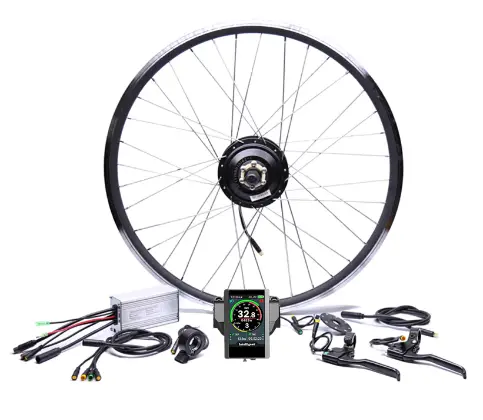
- Front or rear hub motor laced into a rim
- The motor controller (the electronic brain of the system)
- LCD or LED display – for speed, battery range, etc.
- Wiring harness
- Pedal assist sensor
- Brakes with integrated sensors (for mechanical brakes)
I’ve installed, both the 250-watt and 500-watt versions of the Bafang e-bike conversion kit. These kits are a great way to give old, unloved bikes a new lease of life.
Compatibility
Before buying one of these kits, you’ll need to check the wheel size of your bike. If you do not know the size, it can be found on the side of the tire, for example, 26″ / 599 (ISO) 27.5 / 584 (ISO) 28″ / 622 (ISO) – PLEASE NOTE: If you are installing this kit on a 29er mountain bike, then you will require the 28″ (622) wheel size. For more information on tyre and wheel sizes, check out this tyre and wheel sizing article by the great Sheldon Brown.
These motor kits are only compatible with standard rear drop-outs (135mm wide). They will not fit bikes with thru-axles. Nearly all cheaper bikes have standard quick-release dropouts. But if you are considering installing this kit on a higher-end mountain bike or road bike, you must double-check. The fat bike version of these kits will be compatible with the wider 175mm dropouts of those bikes.
Finally, You will need to check the kind of bottom bracket your bike has fitted. If it is a standard square-tapered BB, then the pedal sensor should fit. If, however, you have an Octalink / ISIS or Hollowtech ll type BB, then you will need to purchase a separate pedal assist sensor.
If your bike has flat handlebars with mechanical rim or disc brakes, the supplied brake levers with cut-off sensors will be a straight swap. Unless you have integrated gear shifters and brake levers, you have hydraulic brakes, or you have drop handlebar (STi) shifters.
Installation
Installing a Bafang hub motor conversion kit is straightforward, and requires minimal skill – it should take roughly 2-3 hours to complete the job. It should be noted that you will require a basic bicycle maintenance tool kit to do the job properly. Things like a crank puller are essential to remove the right side pedal crank to fit the pedal assist sensor.
The installation process involves removing your existing wheel and swapping over your rim tape, inner tube, tire and any other components like disc brake rotor and gear cassette/freewheel. You install the motorised wheel and fit the other ancillary components like the pedal sensor, display and battery. Plug everything in, and away you go!

Conclusion
Overall, the Bafang hub motor is one of the best available. They are generally durable, and fairly weatherproof. Out of the dozens of kits I’ve installed over the years, there have been very few long-term issues. One of the big benefits of fitting a Bafang hub motor over a mid-drive is there’s hardly any pedalling resistance. Plus, fewer internal parts to go wrong.
From the perspective of an e-bike buyer, thinking of purchasing a factory electric bike with a Bafang motor, I can highly recommend it. Out of all the e-bikes I’ve tested over the last few years. I can’t think of a single time, a Bafang has given me cause for concern. That’s not to say problems don’t arise from time to time, but my personal experiences with this motor have been positive. Even in 250-watt form, it produces a good turn of speed and a very useful boost on hills. If you are regularly riding very steep hills, I would stick with a mid-drive.
The 750-watt version is a joy to ride and a great mile-muncher! Fit a 52-volt battery with a 25-amp controller, and you will have peak power approaching 1500 watts – this is the maximum recommended output for this motor, and you shouldn’t go beyond that.
All in all, the Bafang hub motor is a great choice whether you’re thinking of converting a bike or buying a factory e-bike.
Thanks for reading my Bafang hub motor review. If you have any questions, please feel free to leave a message in the comments section below – I aim to answer all queries within 24hrs.
Specifications
The specifications below cover the whole spectrum of Bafang hub motors, ranging from their e-city range to their e-cargo and e-MTB motors. Most e-bike conversion kits that use the Bafang motor will be the standard G20 model.
| Motor Fitment | Front or Rear Hub Motor |
| Motor Power | 250w – 1000w |
| Motor Voltage | 36-volt or 48-volt |
| Motor Torque | 35Nm to 95Nm |
| Compatibility | Quick-release dropouts |
| Dropout Width | 100mm (front) – 135mm (rear) 175mm (fat tire bike) |
| Motor Weight | 2.75 kg – 4.5 kg (approximate) |




Thank you for all the information. Very valuable. I have a question: I am about to buy a cargo bike with a Bafang RM G070.250/350/500.D (350 version) which is marked as DC36V.
It is paired with a Samsung 36V battery, all I know about the controller is that it is 20A and it has a KM-529 LCD (King-Meter).
It seems very odd to me that I cannot find much about the 350W version of this motor online. Bafang states 65NM Torque. Will I get this Torque out of it with 36V, if anyone has experience with this motor? Or should I and can I upgrade to 48V?
Hi Martin,
I personally wouldn’t run a 48v controller and battery on a 36v motor – I’ve tried this in the past and it didn’t end well!
The torque figures are in my opinion optimistic and probably closer to 35-40Nm. Having said that I’ve installed a couple of 350w Bafang rear hub motors on to heavy hybrid bikes and the performance is decent enough. Peak power should be up around 750w with a 20A controller and 36v battery.
All the best,
Tony
Hi Tony,
Great web site. Very helpful for the growing band of electric bikers.
3 years ago my Trek Tandem was converted by Cyclotricity and fitted with a 500W (restricted) 36V rear drive motor. It has worked well until I got a puncture recently. On putting the rear wheel back together the rear motor occasionally made a graunching noise and vibrations could be felt when sat on the bike. This has been intermittent until recently when it stopped working altogether. I have removed and replaced the wheel, checking torque washers, wheel alignment, cable connections etc and all is well. I also get Error Code 3 on the display but cannot find out what it means. The bike will not drive using the throttle either. I am unable to contact Cyclotricity by email or phone and assume they are no longer operating. Can you give me any advice? Also, if I am forced to buy a new conversion kit, I am considering buying the Bafang H400 250W 36V rear drive system with a 14 AH battery. Is this a suitable choice for a tandem carrying a combined weight of 23 stone?
Alan
Hi Alan,
It sounds as though the hall sensor has failed in the motor – this is not unusual on a 3 year old motor. I’m assuming it’s the direct drive 500w motor (gearless). Hall sensors are very cheap, but require good soldering skills to replace (and a lot of patience!). To access the hall sensor, you will need to remove the motor cover and locate the circuit board within the motor housing. If you are good at precision soldering or know someone who is, then it should be doable. You will need to identify the correct hall sensor and go to RS components – they are usually between 50p – £2 each.
If you decide to go with a new kit, the Bafang H400 should be more than up to the job. The Bafang is a geared motor so it will be lighter, more efficient and produce more torque than your existing motor. Even though they are rated at 250w, it will still produce around 500w peak power when under load. I’ve installed a lot of Bafang hub motors over the last 4 years and have only had a couple of isolated problems.
I hope this helps. If you need any more advice, please let me know.
All the best,
Tony
Hi Tony,
I have a Bafang 36v 250w rear hub motor installed on my bike together with a c300s display under the branding of ecobike. However the display does not give you the access to change the speed limit and if I got it right this could be fixed by just changing the display?
So if the speed limit can be changed by just fitting a new display, which displays will work with the bike.
Hi Joel,
If your display uses a standard 5-pin higo (circular) or block connector then there should be a few options available depending on the controller – if it is a ‘KT series’ controller then a KT-LCD3 display would be the best option as these can be easily configured for speed limit and other parameters. If you need a manual for the C300s display here is a link to a PDF copy.
Regards,
Tony
Hello Tony,
Thanks for the help last time. However now I have this KT series display and I wonder what happens if I connect it to a lishui controller, will it work, break, or just do nothing.
Thanks again!
Hi Joel,
I’ve never used a Lishui controller with a KT-LCD3 display before. I found a thread on Pedelecs UK that mentions connector incompatibility – here is a link to the forum topic.
Regards,
Tony
Hi Tony, any thoughts on this bafang kit ?
https://www.affordableebikes.ca/collections/diyconversionkits/products/complete-conversion-kit-26-inch-front-wheel
Hi,
Looking at the specification it looks like decent value for money. I notice the battery uses Panasonic cells, which is a good thing, as they are good for longevity and reliability.
All the best,
Tony
Hi great site, have two questions i fitted a front wheel Yose kit to my Bacchetta giro 20 works really well but had to file dropouts to get wheel to fit. With rear kits do they fit with no filing. Looking at Woosh kits and they seem mostly to come with 48v batteries are these better than 36v. Sorry if these questions are basic. Kind regards Mark.
Hi Mark,
Regarding the fitting of rear kits, it depends on your dropouts. If find sometimes the motor will fit just fine and other times you need to file. You need to make sure the dropout spacing is 135mm at the rear – I’ve fitted the Bafang hub motor to Ice Trikes before and also a couple of other recumbents without any problems.
Going with 48v is the better option on a 250w kit as it will allow the motor / controller to run a little cooler as it won’t need to draw the same current as with a 36v system.
All the best,
Tony
Thanks for your enlightening comments, interesting battery comment thinking 48. I can see it depends on what dropouts a bike has. Great site thanks for all your hard work. Mark.
You’re welcome.
Cheers, Tony
Hi Tony,
I’m really glad I came across your website. It’s very informative.
I recently purchased a Polygon Impression tandem bike. Link here https://www.bicyclesonline.com.au/2021-polygon-impression-ax-tandem-bike-with-disc-b and am planning to add a Dillenger Off road kit. Link here https://dillengerelectricbikes.com.au/collections/off-road-kits/products/premium-offroad-electric-bike-kit I can’t tell if the motor is a Bafang unit.
Together, my wife and I weigh approximately 121kg; the tandem weighs 18.5kg; and the kit weighs 8.5 kg; totalling 148kg. Do you think the motor can handle the weight? The area we ride in have some moderately steep hills, and we plan on using pedal assist but using the throttle when absolutely necessary. Also planning to convert the bike to 1×10, with 34T in front, and 11-32 cogs. Would appreciate your feedback on this set up.
Thanks.
Jonas
Hi Jonas,
I’ve just checked out the images on Dillenger’s website and the motor manufacturer is Shengyi (hence the SY serial number). These motors are fairly comparable to Bafang in terms of reliability and performance. I have installed quite a few over the years (including one on a recumbent trike) and they have always been reliable and performed well.
You should be fine with the weight, I weigh in at nearly 110kg on my own and I fitted a front drive Shengyi motor to a steel-framed Surly LHT touring bike (15kg) a while back and I could still climb 15-20% gradients – although I still had to put in a fair bit of pedalling effort to help the motor (48v 500w). On moderate climbs of 6-8% it was absolutely fine.
Regarding the gearing, I would get a long-cage rear derailleur if possible and go for an 11-36 cassette – it depends on how long/steep the hills are. It’s always useful to have a ‘bail-out’ low gear just in case.
I hope this helps, if you need any more info, please let me know.
All the best,
Tony
Hi Tony,
Wow, didn’t expect such a quick reply!
I’ve inquired with Dillenger and the 10spd freewheel that they have is 11-32 max. I wish it could take a cassette. Oh well. They were also iffy about the motor vs the weight issue. Probably concerned about warranty issues, and rightly so. But as you said, and based on research, I also figured that it shouldn’t be a problem. Thanks for your advice ??
Based on the photos, can you tell what the model of the display is? Curious to see if anything can be modified. Although my wife would probably freak out if she knew we’d exceed 25kph off road. Having never ridden a tandem before, I was pleasantly surprised how fast you can go on flat terrain.
Cheers, mate.
Jonas
Hi Jonas,
The display looks identical to a Bafang C965 B&W LCD display (but with Dillenger branding). Apart from changing basic settings like wheel size, max assisted speed and metric to imperial, there’s not a lot you can do with that particular unit. They are fairly basic but generally reliable and easy to use. I’ve brought Dillenger kits here in the UK before and they’re generally pretty good. You should be fine with an 11-32 as long as you don’t have any ridiculously steep hills to climb.
All the best,
Tony
Hi Tony
You helped me in the past with my front 500w 48v BPM motor build. It got delayed through one thing or another but now its finished. I was wondering about the LCD 3 settings. P1and P2 ?
ie your spec sheet says reduction ratio 1:4.42 so reduction ratio x number of magnets (20) would make it 88 ? also do you know what P2 should be ? looking at your spec sheet again it looks like there is only one motor pulse magnet so should that be one ?
I have a Bafang BPM 500w 48v 20(13) motor built into a 700c wheel with a KT LCD 3 and KT controller rated at 10a max 20a
As always I appreciate the time you take to answer out questions.
Many Thanks
Steve
Hi Steve,
The 20 magnets and 1:4.42 reduction ration applies to the 36v 250w motor. I’ve just double-checked on the Bafang website and the BPM 48v 500w front motor is 16 magnets and 1:5 reductions ratio, which means P1 should be set to 80, and P2 should be set to 6 as the 500w motor uses 6 pulses for the speed detection signal. Try it and let me know how you get on.
Cheers,
Tony
Hi Tony
The P1 value works fine, the P2 value (6) gave a 0/1 MPH reading as did a all the the other settings. except 5. I have been out with my wife on her Cube crank drive comparing speeds and the P2 setting of 5 seems to be quite accurate so I’ll leave it there.
Thanks once again for your help.
Regards
Steve
Hi Tony, I have also purchased avaris 3.6 ebike and cannot fathom out how to unlock the speed settings, there is a 9 pin lead but cannot find 9 pin to usb adapter to use the speed app, any help appreciated
You’re welcome.
All the best,
Tony
Hi Tony
Thanks very much for that, I had just assembled everything out the box and it runs ok but I feel it could be smoother. Hopefully this will improve things. I had looked on the internet for the specs but didn’t find this Bafang website, so thanks for that. I will adjust the settings and report back.
Best regards
Steve
?
Hi Tony
I fitted a Bafang rear hub motor 15 months ago and it has worked really well for 1500 miles. I went to ride it yesterday and, when I started peddaling the motor started as usual but when I stopped pedalling the motor continued so pushing the chain along the top of its run and weakly drove the pedals around – positive feedback. The motor would only stop when I braked and cut in again if I stopped braking while the pedals were still rotating. It seemed to have lost its proportionality ie running at full speed even when the pedals were going slowly. I’ve checked the wiring and cannot find a problem. There is no error code and no throttle fitted and its not set for assistance while pushing. Any idea if this is the speed sensor or the controller that is at fault? Where can I get spares if so? Al help much appreciated.
Hi Colin,
It’s not a problem I’ve encountered personally. It could be a possible fault with the pedal assist sensor or the circuit inside the controller. In my experience the pedal sensors can be problematic but they’re cheap to replace so that would be a good starting point. If you rule the sensor out then the controller is likely to be at fault.
Depending on your set-up you will need either a 36v or 48v controller – there are dual voltage controllers available and you will need to make sure the connectors are compatible. Some controllers use the old style block connectors and some use the circular Higo connectors. I’ve just had a look on eBay and there’s quite a few options, but you may need to go to Aliexpress and order one direct from China. A lot of Bafang conversion kits use ‘KT’ controllers which are very common, if you have a ‘KT’ controller and display there may be a issue with cross-compatibility with other controllers.
Let me know how you get on, if you need any more help let me know.
Cheers,
Tony
Hello.
I hope you can help me.
I have a motor kit with bafang 500w, similar like in this article. I found that when I start moving the voltage goes down from 54v to 48v or lover. If I put percentage on the screen it decreases from 100% to 87% or at least 10% less while riding, when battery is lower than 50% it can show 0% sometimes. I meet the same thing on others bafang hubmotor kits with different batteryes. Controller is YCSV126-017-48T.
I put same battery to Bafang BBS02 750w with same display (850c) and no voltage drop was mentioned. Only mby 1-2% on maximum power.
Motor works fine.
Is it normal to when display shows such things, or it is an issue?
Did you met same indications?
Are there possibilities to fix it?
Thank you so much.
Hi,
It’s quite common for the displayed voltage to drop (on the 850c display) due to voltage sag on the battery, particularly if you are using full power. This is quite normal and really depends on the quality of the battery – a high quality battery with thick copper interconnectors between the cells will have less sag than the typical nickel connectors used.
Dropping 6v does seem a little high though – I would ride it and see what sort of range you get. My friend has a 36v 500w Bafang hub motor with 36v 14.5Ah battery and he gets about 20-30 miles in medium to high setting.
I hope this helps, if you have any more questions please let me know.
All the best,
Tony
Hi Tony,
Looking for help. I have a JuicedBikes Crosscurrent X which has a Bafang 48V (52V battery) 750W rear hub motor (BFSWX02 (10) 700C. The wheel size is 700c. A couple of weeks after the 1 year warranty ran out most of the time I brake I get a moderately load squealing/shuttering noise from the hub and it feels as if the brakes are still on (which they are not). After pumping the brakes a bit the noise goes away and power is restored. General riding is fine, but something is not working and it’s getting worse as is occasionally happening while I ride now (without applying brakes), but mostly happens after braking. My questions: is this a failed hub motor or is there a sensor that could be the problem. What is the right replacement for this rear hub motor – as I can’t find any equivalent replacement. The 26inch fat wheel replacement exists, but not the thinner 700C version for a 750W. I haven’t found a bike shop in the DC region that repairs or even replaces rear hubs. Probably could do it myself, but can’t find a replacement. Any advice?
Hi Michael,
I would start by unplugging the e-brakes to see if the problem still persists. It sounds like an issue with the brake cut-off circuit. Usually if there’s a problem with the motor it will lose power constantly (hall sensor) or make a rough grinding noise (planetary gears inside the motor). According to the website your bike uses hydraulic brakes with integrated sensors, there could be a fault with the brakes or possibly the wiring harness that goes to the motor controller. I’m fairly sure you can buy compatible replacements brakes from Amazon or eBay. JuicedBikes sell a replacement wiring harness on their website.
Most faults with the motor can be resolved easily enough. The planetary gears can be purchased direct from China from greenbikekit.com. The hall sensors are located on a circuit board inside the hub, replacing them requires good soldering skills.
I hope you manage to get it sorted.
All the best,
Tony