

When you purchase through links on our website, we may earn a commission. Affiliate disclosure.
In this Bafang hub motor review, I look at this high-performing and reliable electric bike hub motor. It’s relatively cheap while offering a significant boost in performance for day-to-day riding. This makes it a popular choice among DIY e-bike builders and manufacturers. In this article, I will examine its features, benefits, and drawbacks based on six years of experience with this motor. Find out more about my electric bike conversion service.
Since this article was posted four years ago, Bafang has been very busy! Their hub motors are now found on nearly 70 well-known brands and many lesser-known brands. In addition, the Bafang hub motor range now includes 12 rear motors and three front hub motors covering multiple uses from electric cargo bikes, city bikes and fat tyre e-bike applications.
Key features
- Various power options are available from 250w – 1000w
- Fitment for standard or fat bike wheels
- Supports torque-sensing controller and bottom bracket
- Available in 36v or 48v (will handle up to 52v)
- Available in kit form or as OEM motor on factory e-bikes
- Price: From £250 to £450 depending on the supplier ($300 – $500 approx)
Pros and cons of the Bafang hub motor
Pros
- High torque and efficiency: The Bafang uses a brushless motor with planetary gears. Small geared hub motors produce more torque than direct-drive motors, making them better for climbing hills. They are also much easier to pedal with the power switched off, making them much more suitable for someone who only needs the assist on hills.
- Ease of installation: If you’re fitting the Bafang as part of an e-bike conversion kit, it’s relatively easy to install. The motor kits usually come with all the necessary hardware and instructions, making it a straightforward process even for those without much mechanical experience. Additionally, the motors are available in various wheel sizes, so you should be able to find the right one for your bike.
- Cassette and freewheel gear options: There are two options for gearing – one will take the old-style screw-on freewheel (usually 6 or 7-speed), and the other will take a mountain bike cassette of 8 to 11-speed. The cassette version will not take a road 11-speed (like Shimano 105), as spacing is different and requires a slightly wider freehub.

Cons
- Weight: While the Bafang hub motor has many benefits, it has some drawbacks. One of the biggest drawbacks is weight. Although it’s now much lighter than previous incarnations, it still comes in at nearly 3 kg at the lower end.
- Not compatible with modern thru-axles: Another drawback of the Bafang hub motor is it’s only currently available for quick-release dropouts. With an increasing amount of new mountain bikes using thru-axles and boost rear hub spacing. If they want to stay ahead of the game, Bafang must offer this option for DIY e-bike builders.
- Premature motor wear: Reliability is generally good, but as with all electric motors, there can be problems from time to time. I have personally experienced hall sensor failure and premature wear of the nylon planetary gear. If you did experience problems down the line, parts are readily available, and the motor is easy to service for a competent DIY enthusiast.

Motor performance: 250w variant
I’ve owned several e-bikes with this motor. Indeed, my latest electric bike uses a 250w Bafang motor. In my experience, Bafang hub motors offer solid performance, from the 250w version right through to the 750w version.
The 250w Bafang hub motor is usually used in conjunction with a 36-volt 15-amp controller. This will give a peak power output (under load) of 540 watts. Peak output will depend on other firmware settings specific to the controller used. In addition, if a 48-volt controller is used, then peak power will be substantially more. I’ve ridden a road-legal e-bike with 48v Bafang 250w, and peak power was showing (on the display) at over 700 watts.
It seems the continuous motor rating (250w) is important for legality, but higher power outputs when under load are acceptable. The Bosch CX motor produces a peak power of around 600 watts.
Bafang offers a torque-sensing option – for OEM only, and unfortunately, not in conversion kits. The new Eskute Polluno Plus has this configuration, and it works well. The torque-sensor unit is housed inside a Bafang-branded bottom bracket. This system works incredibly well – it provides instantaneous electric assist the second you start to pedal. The torque sensor measures the pedalling force and adjusts the motor output accordingly. This drastically improves efficiency and riding experience.
Find out more about the pros and cons of a hub motor vs a mid-drive motor.

The other option is a cadence sensor – this is found on budget factory electric bikes like the Eskute Voyager, and Bafang e-bike conversion kits. The newer cadence sensor is an enclosed unit that slots into the splines on the bottom bracket. This kind of pedal assist has a much more on / off feel to it – you can ghost pedal (spinning the pedals without effort in a low gear), and you’ll still get assist. Controller firmware is usually programmed so that when a higher cadence is reached, the motor current is dialled back.

A 250w Bafang hub motor has enough power to comfortably get you up a 10% climb. But, steeper hills will require additional effort from the rider. The gearing on the bike will also be a contributing factor when negotiating steep hills – lower gearing = easier hill climbing.
For a 250-watt hub motor, the Bafang performs very well and will provide enough pedal assistance for most riders. Its limitations are only noticeable on very steep hills, but for moderate hills, it does the job.
Motor performance: 750w variant
The 750-watt Bafang hub motor tested here was fitted to a Cyrusher XF800 fat tyre e-bike. This motor is used in conjunction with a 48-volt 25-amp controller, giving a peak power of 1200 watts. When the battery is fully charged @54.4-volts, peak power will top out at 1360 watts.
Considering the heavy weight of this electric bike (32 kg), the performance of the motor is impressive. The cadence pedal assist sensor delivers a smooth, but strong surge in power. The power builds rapidly and pulls strongly up to 28 mph.

This motor is noticeably noisier than its smaller sibling, but the noise is never intrusive. I tested this particular bike on a couple of very steep climbs with a maximum gradient of around 20%. Although the motor did start to struggle a little on the steepest section, it still got me up there without me getting out of breath.
Where the 750-watt Bafang comes into its own, is on rolling terrain with moderate hills – you can cover ground fast, and it’s not too difficult to keep the average speed above 20 mph.
What’s included in a Bafang e-bike conversion kit
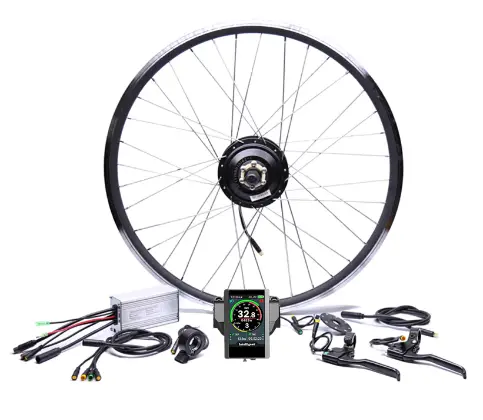
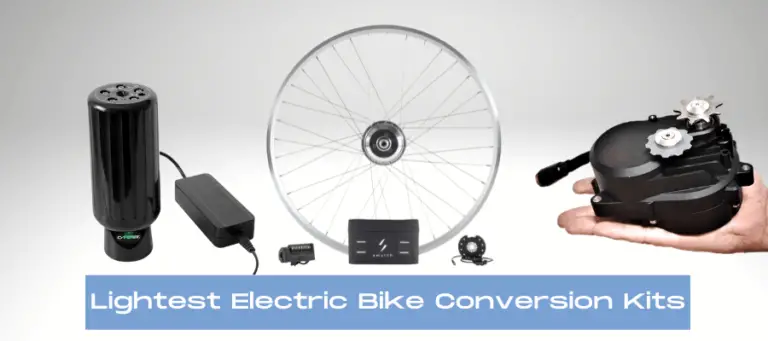
- Front or rear hub motor laced into a rim
- The motor controller (the electronic brain of the system)
- LCD or LED display – for speed, battery range, etc.
- Wiring harness
- Pedal assist sensor
- Brakes with integrated sensors (for mechanical brakes)
I’ve installed, both the 250-watt and 500-watt versions of the Bafang e-bike conversion kit. These kits are a great way to give old, unloved bikes a new lease of life.
Compatibility
Before buying one of these kits, you’ll need to check the wheel size of your bike. If you do not know the size, it can be found on the side of the tire, for example, 26″ / 599 (ISO) 27.5 / 584 (ISO) 28″ / 622 (ISO) – PLEASE NOTE: If you are installing this kit on a 29er mountain bike, then you will require the 28″ (622) wheel size. For more information on tyre and wheel sizes, check out this tyre and wheel sizing article by the great Sheldon Brown.
These motor kits are only compatible with standard rear drop-outs (135mm wide). They will not fit bikes with thru-axles. Nearly all cheaper bikes have standard quick-release dropouts. But if you are considering installing this kit on a higher-end mountain bike or road bike, you must double-check. The fat bike version of these kits will be compatible with the wider 175mm dropouts of those bikes.
Finally, You will need to check the kind of bottom bracket your bike has fitted. If it is a standard square-tapered BB, then the pedal sensor should fit. If, however, you have an Octalink / ISIS or Hollowtech ll type BB, then you will need to purchase a separate pedal assist sensor.
If your bike has flat handlebars with mechanical rim or disc brakes, the supplied brake levers with cut-off sensors will be a straight swap. Unless you have integrated gear shifters and brake levers, you have hydraulic brakes, or you have drop handlebar (STi) shifters.
Installation
Installing a Bafang hub motor conversion kit is straightforward, and requires minimal skill – it should take roughly 2-3 hours to complete the job. It should be noted that you will require a basic bicycle maintenance tool kit to do the job properly. Things like a crank puller are essential to remove the right side pedal crank to fit the pedal assist sensor.
The installation process involves removing your existing wheel and swapping over your rim tape, inner tube, tire and any other components like disc brake rotor and gear cassette/freewheel. You install the motorised wheel and fit the other ancillary components like the pedal sensor, display and battery. Plug everything in, and away you go!

Conclusion
Overall, the Bafang hub motor is one of the best available. They are generally durable, and fairly weatherproof. Out of the dozens of kits I’ve installed over the years, there have been very few long-term issues. One of the big benefits of fitting a Bafang hub motor over a mid-drive is there’s hardly any pedalling resistance. Plus, fewer internal parts to go wrong.
From the perspective of an e-bike buyer, thinking of purchasing a factory electric bike with a Bafang motor, I can highly recommend it. Out of all the e-bikes I’ve tested over the last few years. I can’t think of a single time, a Bafang has given me cause for concern. That’s not to say problems don’t arise from time to time, but my personal experiences with this motor have been positive. Even in 250-watt form, it produces a good turn of speed and a very useful boost on hills. If you are regularly riding very steep hills, I would stick with a mid-drive.
The 750-watt version is a joy to ride and a great mile-muncher! Fit a 52-volt battery with a 25-amp controller, and you will have peak power approaching 1500 watts – this is the maximum recommended output for this motor, and you shouldn’t go beyond that.
All in all, the Bafang hub motor is a great choice whether you’re thinking of converting a bike or buying a factory e-bike.
Thanks for reading my Bafang hub motor review. If you have any questions, please feel free to leave a message in the comments section below – I aim to answer all queries within 24hrs.
Specifications
The specifications below cover the whole spectrum of Bafang hub motors, ranging from their e-city range to their e-cargo and e-MTB motors. Most e-bike conversion kits that use the Bafang motor will be the standard G20 model.
| Motor Fitment | Front or Rear Hub Motor |
| Motor Power | 250w – 1000w |
| Motor Voltage | 36-volt or 48-volt |
| Motor Torque | 35Nm to 95Nm |
| Compatibility | Quick-release dropouts |
| Dropout Width | 100mm (front) – 135mm (rear) 175mm (fat tire bike) |
| Motor Weight | 2.75 kg – 4.5 kg (approximate) |



Hi Tony
I have spent hours on your site and its one of the best. I have got interested in a BPM 48v 500w hub motor for my next build. Its hilly where i live and want to try one. I have read everything on this thread but still have 2 questions. As its a front build I am going to use Surly LHT steel forks with a torque arm or 2 if you think it would be better, do you think that should be a good safe option.
I have a 15amp controller but should i get something a bit more powerful, i don,t particularly want speed but would like to have hill climbing power but not at the expense of stressing the motor.
Thanks in advance for any advice.
Hi Stephen,
You will be fine with Surly forks. I converted a Long Haul Trucker a while back with a front motor and it worked a treat. My friend has a Bafang 36v500w CST rear motor fitted to an old Giant XTC, and he flies up the 15% climbs in my area. His set-up has a 22A controller – he’s 66 years old with knee problems and I have to work like hell to keep up with him on the hills (riding a regular road bike). I’ve always found one torque arm to be sufficient.
All the best,
Tony
Hi Tony
Many thanks for your prompt reply. I’m 70 and have knee problems so sounds like it will do me also.
Great site keep up the good work.
Regards
Steve
Hi Steve,
Glad to have been of help. If you have any more questions, please ask.
All the best,
Tony
Hi Tony
Not sure which way to go, either buy an ebike ready to go or cheaper option, buy a kit to fit my specialized allez sport road bike. It has Shimano Sora combined brake and shifter levers. I see in the items in the kit, you didn’t mention brake levers, yet in the photo of parts, 2 brake levers are shown. Are these supplementary to the operation of the kit. Cannot see any way of installing the kit if I have to change the brake levers, in which case I would have to buy a ready to go ebike?
Great, informative website
Hi John,
The brake cut-offs aren’t compatible with STi shifters, but I very rarely install them. The only time I would see the need for cut-off sensors would be on a high-powered conversion that uses a separate throttle (independent of pedal assist). You will need to get a Hollowtech II compatible pedal sensor though as the one supplied with most kits is only suitable for a square-tapered BB.
If you have any more questions, let me know.
Cheers,
Tony
Hello, thank you for this post.
I have this bike https://eu.dahon.com/bikes/eco-c7/ and I was wondering whether I could get your recommendation on a complete kit to purchase in order to convert it to an ebike.
Thank you!
Hi Patrick,
The easiest way to convert your Dahon folding bike would be a 20″ front wheel electric conversion. Here is a link to a seller on eBay I have used many times before. Their motor kits are very reliable and come with a toolkit. They also sell batteries like this one and ship from the Netherlands.
All the best,
Tony
Hi Tony
My 48v 500w BPM build is coming on. I have been reading your site on BBS 2/HD mid drive motors and you talk about the reduced safety margin with 52v batteries over 48v. I am thinking of getting a 52v battery for my BPM front motor and wonder if this also the case with hub motors.
I am using a KT36 controller with max of 25 amps if this is important.
Regards
Steve
Hi Steve,
I have used 52v batteries with Bafang 48v 500w BPM and CST motors in the past (in conjunction with 48v KT controllers) without any long-term issues. The KT series controller seems to handle the extra voltage no problem.
I hope this helps.
All the best,
Tony
Many thanks Tony
You’re welcome?
Hi Tony
I have a Bafang 36v 250w rear hub motor installed on my bike together Bafang Display DP C10 UART. Both are branded under name “Egoing”. I would like to unlock the speed limit 25km/h to increase it at least to 30km/h. I’ve been looking around, especially on youtube and many are able to do this by entering something called “Password Menu” on the display. When they enter the password “0512” on that page, they are able to change wheel size, speed limit etc.
However, on my bike, I’m not able to find this menu. I can only see what speed limit is set to but cannot access the “Password Menu” page. Do you have any idea how this page can be accessed on “branded” bafang motors? Can this be done by changeing the display to a “unbranded” bafang display (original with bafang logo)?
I have also a question regarding the battery. Can a 48v battery be installed for better performance (on 36v 250w motor?)
Thank you
Hi,
It’s likely the display has been ‘locked out’ to prevent the user from altering the speed limit (to comply with ebike law). You should be able to swap the display out for something like a C965 or DP-C18. You could change to a 48v battery but you would need to purchase a 48v compatible controller (ECU box). You can get the same power with less current (amps) using a 48v battery and as long as you keep the current low, you shouldn’t have any problems.
Regards,
Tony
Hello Tony
Thanks for the quick reply. That’s what I believe too. Do you mean that all the settings are programmed into the display? By changeing display, I would access and change the speed limit?
“..using a 48v battery and as long as you keep the current low, you shouldn’t have any problems.” Could you explain a bit more in details?
What I expect/understand from this upgrade is that the battery will feel more “fresh” even if 50% of the battery is discharged comparing to a 36v. And extended range with the same Ah.
Yes, by fitting a new display you should (in theory) have access to all the settings in the advanced settings menu (accessed with the passcode 0512 on the C965 display).
You are correct regarding the battery – a 48v battery at full charge is 54.4v vs 42.2v for a 36v. The motor will use less current to achieve the same power output.
All the best,
Tony
Hi Tony I loved your posts.
I have the same “problem” with my Buddy Bike C3. With the C600E-180-H734. display
It is a Bafang 350W rear hub motor nominally limited to 250W” with a rotation sensor.
On the backwheel it is written: bfswx02 36v ( 10)
I am looking to change some of the settings, and are looking for a Usb programming cables. But al the cables I find is refering to: 8fun / Bbs01 Bbs02 Bbs03 Mid Drive / Center Electric Bike Motor Programme. Can I use the same cable or do I need another cable?
Hi,
Unfortunately it’s not going to be straightforward to reprogram this system as the controller is different than the one used in the BBS mid-drive motor. You should be able to adjust the speed limit through the display. Here is a link to the C600E manual. If the system is ‘locked’ and cannot be speed adjusted, the only other option would be to replace both the motor controller and display together. Bafang-compatible controller/display options like the KT 36v 22A controller with KTLCD3 would work.
Regards,
Tony
Tony, can you answer a quick question……..I’ve been running a BF BPM 48v500w 20 (13) front motor on a recumbent. Works great on a 24″ wheel. I bought a 2nd motor, but in a mix up, I got an FM GO20.500.D motor. The FM motor is in a smaller/fatter case. What’s the difference? -Don
Hi Don,
As far as I know the GO20.500D is the later version also known as the BPM2, it looks like it runs at a higher rpm which should be better for efficiency and longevity.
I hope this helps.
All the best,
Tony
Thanks Tony. I got a chance to run the GO20.500.D 11 motor today on a 451 20″ front wheel. It runs great. But the 850c display (or controller) doesn’t quite work. The throttle is fine but the PAS does not work and the speedometer reads about 4 times faster. So do I need a new display only, or a new controller and display? Or is the 850c programmable for this different motor? (is this some setting issue with the poles in the motor?).
Thanks for the help.
-Don
Hi Don,
Does your controller serial number start with ‘KT’ if so it is likely to take the speed measurement from the motor, although some versions of this controller use an external speed sensor (with wheel magnet on spokes). There is an advanced settings menu on the 850c, but I only have experience using this in conjunction with the BBS mid-drive motors. If you do have a KT controller, it might be worth trying one of their displays. The KT-LCD3 display can be configured for the amount of magnets inside the motor and also the number of magnets on the PAS sensor – this might be the source of your issues. They also do a colour version of the display called the KT-LCD8. This thread on endless-sphere goes into more details for programming the KT display.
I hope this helps.
All the best,
Tony
Very nice writeup. Thanks for providing the skinny on the Bafang hub drives in a nice, tidy package.
I’m helping my son to plan a e-kickbike build based on the Kickbike Fat Max: https://www.kickbikeus.com/product/fat-max/
So, obviously, the PAS will be unnecessary, and I’d like to run it without a display, as well, as its functions would be reduced to a speedo and battery meter. Is it possible to run the motor and controller without a PAS and display?
You don’t see a lot of e-kickbikes because a) you don’t see a lot of kickbikes in the US, and b) they typically have narrow rear dropout spacing that precludes use of a hub motor. The few factory specimens I’ve seen used front hubs, which just seems wrong to me, although I could be wrong. Life would certainly be easier if front wheel drive were a good option for, say, trails and light offroad use. What do you think?
TIA
Hi Erik,
Yes, you can use a Bafang hub motor without the pedal assist sensor. There are throttle units available that plug directly into the display connector on the controller – you would need one that had compatible connectors. Most Bafang kits use Higo circular connections with a separate 3-pin connector for the throttle. If you didn’t want to use a display, I’ve heard it’s possible by buying a USB programming lead – these are designed to work with the BBS mid-drive motor, so I can say for sure if it will work with the hub motor controller but it’s worth a try. You plug in the green connector end of the lead and just cable tie the loose end to the handlebar.
I reckon the front hub motor should work fine on the kick-bike, the only issue you may find is a bit of wheel spin when ascending steeper gravel tracks.
I hope this helps, if you need any more advice, let me now.
Cheers,
Tony
Thanks Tony,
What would the USB programming cable accomplish? I supposed I’d have to define the throttle level? But once the unit was programmed I’d no longer need the USB cable attached to the bike?
I’ll be sure to find a throttle that connects to the display end of the wiring loom, if that’s necessary, but why not just use the throttle connector? Or does the motor controller expect to see a display, and refuse to work if the display isn’t connected?
Thanks again,
Erik
Hi Erik,
Here is a link to an article that will explain the process in greater detail, and also show you different ways you can use a Bafang motor kit without a display.
It should be noted this refers specifically to the Bafang BBS series of mid-drive motors and may not be relevant for the hub motor kit. The hub motor kits usually use ‘KT’ series controllers – these are not manufactured by Bafang, although there is a process by where they can be re-configured (using a bluetooth adaptor). If you can let me know the exact motor / controller kit you decide to purchase, I can send you the relevant links on how to use without a display.
All the best,
Tony
Hello Tony,
Just writing back to confirm that a 52v battery works great with the Bafang 500w front hub motor, in case anyone else is wondering. Tossed mine in a backpack with the controller this afternoon and #1 Son tore it up for a solid 45 minutes without issues. We ended up mounting the display, which is a good thing since it appears that the throttle setting is dependent on the PAS setting, so in PAS 1 the throttle was restricted, but in PAS 5 it could reach top speed. Thanks, again, for all of your help and advice!
Regards,
Erik
Hi Erik,
Thanks for sharing, glad everything is working well.
Regards,
Tony
Thanks again, Tony,
So I’ve ordered a front 48v 500w hub motor kit, and I’m on the hunt for a battery. A 48v motor controller ought to be able to handle 52v, right? I imagine the P850c display might not accurately read the battery capacity, but that shouldn’t be a major problem. Am I on the right track? It would be convenient if we could share my existing 52v smart charger.
-Erik
Hi Erik,
You shouldn’t have any problems using a 52v battery with a 48v controller as most Chinese 48v e-bike controllers will handle up to nearly 60v. I’ve used a 52v battery in conjunction with a 48v Bafang hub motor and 22A controller in the past without any issues.
The P850c should show the voltage correctly (if you have it set to real-time voltage display), but the indicator bar seems to stay full for ages then suddenly drops off quickly. Low voltage cut-off point on a 52v battery is usually around 40v. If you set the battery voltage (in the settings menu) to UBE, it should work okay.
I’ve had a look on eBay.com and most of the batteries there are shipped from China, there’s a few on Amazon.com.
Luna Cycle do some very good 52v batteries – here is a link to their battery page.
I hope this helps.
All the best,
Tony
Hi Tony,
Thanks for great reviews and videos which helped me decide on what kit I should get, much appreciated; keep the info coming. Decided on a Bafang 36v 250w front wheel kit with color display from Power Surround and triangle battery from Unit Pack Power. Have tried a 250w front drive bike up here in undulating County Durham and it did everything I wanted for leisurely touring.
Do you still reccomend these two vendors for the products ive mentioned. If not any alternatives would be usefull. More interested in reliable service than saving a couple of quid.
Again great source of unbiased info – many thanks.
Hello Tony,
Please can you give me some advice. I purchased a Aikema 128SX 36V 500W rear hub engine for my GIANT ATX690 HD, I have my battery 36V 12Ah, now I was wondering which controller and display is suitable? For the max speed limited, if there any controller does not have the speed limited setting.
Thank you,
Law
Hi Law,
Assuming your hub motor has the standard connectors, a KT-series controller and display will do the job. They are available on Amazon.com – I’ve had a quick look and there is a 36v 25A KT controller with a KT-LCD8 color display available – that controller should work with your battery as the rated minimum current (continuous output) is 12A and your battery most likely has a 20A BMS. That should give peak power of close to 900w which is within the operating tolerances of most 500w hub motors. You can also limit the maximum speed through the display if required.
If you have any more question, let me know.
All the best,
Tony
Hi Cliff,
You should be fine with both of those vendors. I’ve never had any problems with the Power Surround Bafang motors and the UPP batteries have been 99.9% trouble free. Apparently UPP now have a European service centre (in Germany) in the event there are any issues with batteries within the warranty period.
Glad you’ve found my website useful. Let me know how the build goes and if you have any questions relating to your build, let me know.
All the best,
Tony
Hi Tony,
Its been a while. Just wanted to let you know how the build went. Ordered a 250w 850C kit from Power Surround. It arrived in three weeks. Fitting was straightforward and used a plastic external electric box on my carrier to house controller and excess wires. Triangle battery took 3 months from UPP but they kept in touch. Delay mostly down to Covid issues and lack of flight space for delivery. Meantime I initiated plan b which had always been on the cards. I purchased a 13.5ah downtube bottle battery from Green Cell on Amazon. Came from Poland in 4 days. This has given me 60 miles with 20% still left. Triangle is 17.5ah and have had over 40miles with 50% left. Green Cell charger packed up after three charges but Green Cell had a replacement in the post next day. Was here in 5 days. Good service I thought. So long term plan was brought forward a bit but looks like I have well over a 100 miles of charge available. Good feature of Green Cell battery is there is a gap between bottom of battery and its carrier which enabled me to use 3 hose clips as well as the bottle mounts to secure the battery.
Only use levels 1 to 3 if needed when dodgy knee starts to hurt so still getting proper exercise. Hence probably the good mileage from the batteries. Used xt90 connectors for each battery so its a quick swop of plugs when needed. Have done well over 100miles now in between the dodgy County Durham weather of late and our Covid lockdowns AND I prefer the flexibility of the pas system to the bosch motored bike we also have
So a big thanks for the web site, the advice and helpful comments from others on the site.
Hope you are all safe down there
Cheers
Cliff Pickering
Hi Cliff,
You’re welcome. Thanks for the update and glad everything worked out for you. I’ve used Green Cell a few times and they are probably one of the best brands available (fairly) locally. It sounds like you’re getting a decent range out of the batteries. I’ve installed a few of those Power Surround kits in the past and never had any long-term issues reported.
The weather’s been pretty bad since before Christmas down here in Cornwall. I had a 100 mile ride planned over the Christmas holidays, but after getting a proper soaking at 7am on Bodmin moor, I had to cut it short to 60 miles. The sunnier days have been nice but due to the frozen country lanes in the morning, I’ve had to make do with shorter afternoon rides. Hopefully with the longer days and spring on the horizon the whole Covid thing will eventually sort itself out – I was planning on getting the train to Inverness and doing the North West 500 (have to wait and see).
All the best,
Tony
Hi Tony,
I agree with many others, you’ve created a great website and it’s really great that you focus on sharing your knowledge with us, thanks for that!
I’ve got one question regarding Bafang 48V 500W rear hub motors. Do these systems have a torque sensor to modulate motor support depending on my peddling (like Bionx or OEM mid-motor systems). I’ve never ridden an electric bike without a torque sensor and I believe that it’s not the same natural feeling when you need to switch all the time the engine support level through the display rather than managing motor support naturally through more or less pressure on the pedals.
So I’ hoping that these Bafang motors have a torque sensor built-in but I’m not sure. Can you help?
Thanks in advance for your support!
Walther
Hi Walter,
Most of the Bafang hub motor kits available online use basic cadence sensors which give more of an on/off assist feel. I’m like you as in I prefer the natural feel of a torque sensor, I prefer the electric motor to be an extension of my own abilities and to be reactive to pedalling input.
Eunorau e-bike store on Aliexpress do a torque-sensing bottom bracket with controller and 850c colour display – although the maximum current of the controller is only rated to 18A. I’ve fitted these before (with Bafang motors) and they do work very well and provide very smooth and natural assist. The main problem is you need to drill a hole on the underside of the bottom bracket shell in order to pull the lead through. You will need to line the hole with a rubber grommet as the coating on the lead coming from the sensor is very brittle. The first one I did I completely messed up and damaged the wiring. Here is the link to the product on Aliexpress.
I hope this helps, if you need any more advice, let me know.
All the best,
Tony
Hi, thanks for the informative and helpful posts. Please can I ask for some advice about a project I’m kicking off?
I’ve just ordered a Bafang 250w front hub motor for a 20-inch wheel (product number FM.G020.250.D-20). Link here https://www.atmparts.eu/p24_eu/eshop/en/2W/FM.G020.250.D-20
I’m planning to run it at 48v, so I’m looking for a 48v battery/controller kit, but I’m a but mystified about which controller to use.
Can you point me in the right direction please? Apologies if this is a stupid question.
Hi Michael,
I would exercise caution using a 48v battery and controller with the 36v Bafang hub motor – You should be okay as long as you keep the current to a minimum. If you have just purchased the motor, you will need a controller, pedal assist sensor and display. Ideally a KT series controller (dual voltage 36/48v) KT-LCD3 or LCD5 display with a PAS sensor. Here is a link to a KT series 48v controller, display and PAS kit from a trusted supplier on Aliexpress. You may also need a motor to controller connector cable (if this isn’t supplied with the motor). It will be a rubberised circular connector on the motor end, with a 5 or 6 pin block connector and 3 phase wires (yellow, green, blue) on the controller end.
I hope this helps, if you have any more questions let me know.
Cheers,
Tony