
When you purchase through links on our website, we may earn a commission. Affiliate disclosure.
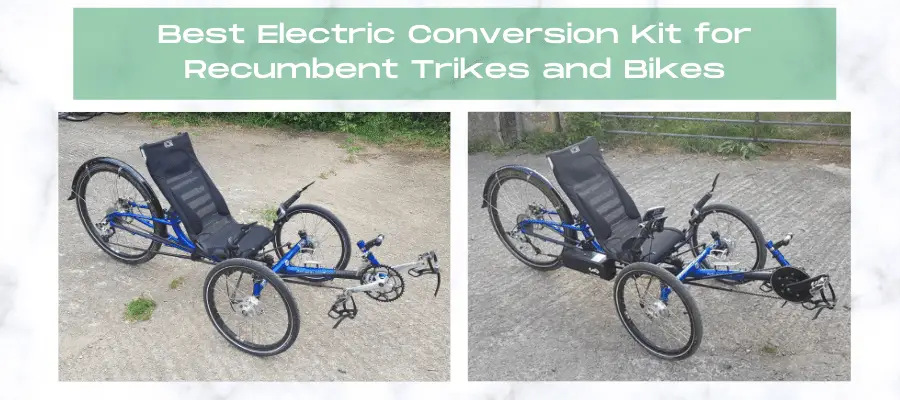
Recumbent trikes are becoming increasingly popular, and I can see why. Up until recently, I had never ridden a recumbent, but the first time I had a go on one I was hooked! In this article, I will be looking at some of the best electric conversion kits for recumbent trikes or bikes.
Due to the extra weight and design, Recumbent trikes (and bikes) are an excellent choice for electric conversion. If you have been thinking about adding E-assist to your recumbent, the great news is most regular conversion kits will fit. Below I will go into more detail on the different types of kits available, and their compatibility.
So what are the best electric conversion kits for recumbent trikes and bikes?
All of the kits listed in this article have been successfully installed, by myself on a variety of different recumbent trikes and bikes. Although these kits are generally reliable, some will require ongoing maintenance. I have been as honest as possible in my appraisal of each kit. If you have any questions regarding compatibility, please leave a comment below and I will respond within 24 hrs.
Do I need a recumbent-specific electric conversion kit?
The simple answer to this question is no. There are some brand-specific kits available like the Terra Trike Bosch boost kit which comes pre-installed in a new boom, but these can be very expensive when compared to the other options listed in this article. You will need to consider several things beforehand. If you are fitting a crank motor you will need to check bottom bracket compatibility (see below). If you are fitting a hub motor, you will need to make sure you get the right-sized wheel – If you have an internally geared hub fitted (like a Rohloff) a rear hub motor would not be an option.
How much power?
This depends on your physical ability. If you have a health issue that prevents you from prolonged periods of exertion, or you are recovering from an injury, then it is likely you would need the electric motor to give you a lot of assistance, and maybe even have a throttle fitted to either get you rolling or enable you to have a break from pedalling once in a while.
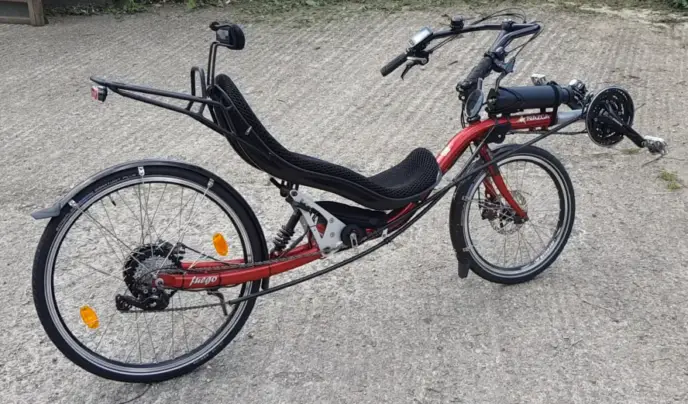
I don’t believe in motors that produce so much power that the need for pedalling becomes redundant as that will cancel out the health benefits of pedalling. But having a motor that complements and enhances your physical abilities enabling you to cycle further for longer and tackle more challenging terrain is a great idea. I know of many fit riders who choose e-assist, not because they’re lazy, but because it enhances the whole recumbent riding experience.
What about Electric bike laws?
The power output you choose will also be important regarding the law in your country. The UK, Europe and Australia for example have a universal 250w power limit and 25 km/h pedal assist limit. In the US, federal law is 750w and 20mph and in Canada, it is 500w and 20mph.
All the recumbents I have converted so far have been 250w, and I find that provides more than enough assistance (and I live in an incredibly hilly area). But my experiences are subjective – I ride between 70-100 miles a week on a road bike, so I am fairly fit. If you are getting back into cycling using a recumbent after a long illness or injury then 250w may not be enough power. This is why I believe the law in the UK and Europe needs a serious overhaul.
You cannot exclude people from a potentially life-enhancing experience like riding a recumbent or bicycle by limiting the amount of assistance they can have. I think a more rational approach would be a 750w upper limit with a 20mph maximum speed just like in the US. Most competent road cyclists can comfortably maintain 20-25mph on the flat and hit speeds of over 50mph on long descents!
Is my Recumbent suitable for E-assist conversion?
If you are thinking about adding a crank motor to your recumbent, one of the most important things to consider is your bottom bracket shell. Most recumbents I have converted have a standard threaded bottom bracket shell, which is usually 68mm wide with an internal diameter of approximately 33.5mm. This would accommodate a regular square-tapered sealed cartridge bottom bracket or a Shimano Hollowtech II or SRAM GPX BB with external cup bearings.
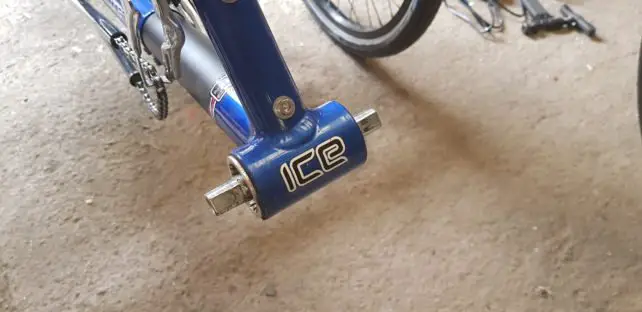
An FSA BB30 pressfit bottom bracket, on the other hand, has an internal diameter of 42mm, so you would need to purchase a BB30 to BSA adaptor shim.
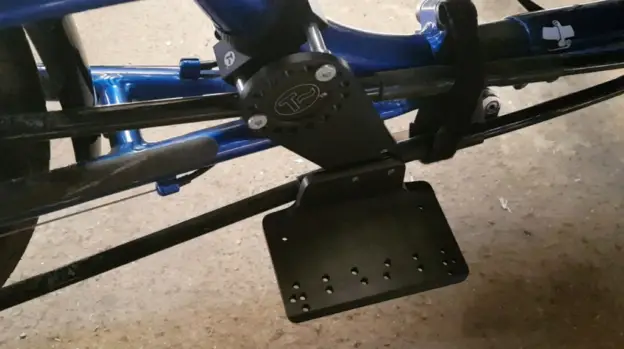
Another important consideration is where to mount the battery pack. Some people prefer to mount the battery on a rear rack, but this can limit space for bags, panniers etc. One excellent solution is made by Terracycle and is a recumbent-specific battery mounting plate.
The two most popular and well-known crank motors – the Bafang BBS and Tongsheng TSDZ2 will fit into a standard bottom bracket shell without any hassles.
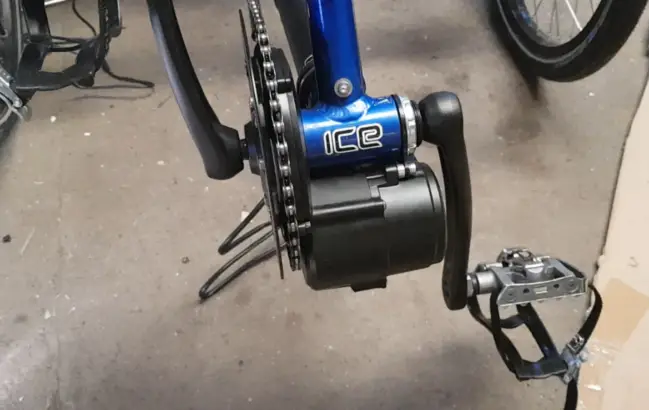
Another thing to consider is gearing. The Tongsheng and Bafang utilise a single front chainring. If you have a triple or double crankset up front you will be going from 27-speed down to 9-speed, although with electric assist this becomes much less of a problem.
Best Electric conversion kits for recumbent trikes and bikes
My top 3 favourite kits for recumbents are ones that I have personal experience installing. None of these kits are perfect and it is worth remembering that compromises may need to be made, but generally speaking, all the kits below have so far served my customers well. That is not to say issues will not occur in future, because unfortunately, any mass-produced electrical item will have chinks in its armour!
Tongsheng TSDZ2
The TSDZ2 has now been around for a good few years and has (thankfully) been improved over the years. Early models proved troublesome, but thankfully the problems are not as frequent as before.
The Tongsheng is a great little motor as it uses a torque sensor (along with cadence and speed sensing) to provide electric assist. This provides the rider with very intuitive assistance. Pedal lightly without applying much force and the motor will not give much in the way of assistance, apply more force to the pedals and the motor will give you assistance proportionate to the force you apply.
The transition is very smooth and this is one of the reasons the Tongsheng is a favourite amongst recumbent riders.
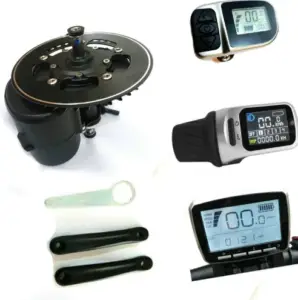
This motor is available in 36v 250w / 350w and 500w variants and also 48 v 350w / 500w and 750w versions.
Why do I think the TSDZ2 is especially suited to a recumbent?
For starters, it is a very small, discreet motor and it isn’t particularly heavy, weighing in at around 3.6kg. There is a threaded hole on the motor, which is important as when you install it you will need to be able to stop the motor from pivoting in the bottom bracket shell. A 38mm stainless steel P-clip is sufficient to secure the motor to the boom of your trike along with a short M8 bolt. This applies to Ice Trikes, as I know other brands will probably have a different diameter on the boom.

It is incredibly efficient – I managed to squeeze a 120-mile range out of a 36v 13ah battery using mainly the ‘ECO’ pedal assist mode. Although this kind of mileage wouldn’t be typical as it would depend on various factors.
This motor produces a lot of torque, making short work of hills. But you will need to be mindful of being in the right gear for steep climbs, just as you would on any bike. Climb a steep hill in a too higher gear, and you run the risk of placing too much load on the motor and risk damage.
One more important thing to remember when using the Tongsheng, is before you switch the motor on, make sure you keep your feet off the pedals. Starting the system with your feet resting on the pedals will hurt the torque sensor calibration. If you do this by accident, just stop riding, turn the motor off, wait for a few seconds and turn the motor on again (making sure your feet are not resting on the pedals).
| Motor | Battery | Peak Power |
|---|---|---|
| Tongsheng TSDZ2 36v (250w variant) | 36v (42.2v x 16A) | 675w |
| Tongsheng TSDZ2 48v (500w variant) | 48v (54.4v x 16A) | 870w |
Reliability Issues
So far I have been lucky with the Tongsheng motor and haven’t had any issues reported to date. Having spent hours trawling Endless-Sphere.com it is obvious that there are several weak points with this motor.
- The blue nylon primary gear can fail prematurely – a brass version of this gear is available as a replacement.
- The sprag clutch or one-way bearing can fail – replacements are easy to obtain.
- Torque sensor – surging or erratic pedal assist can signal problems with the torque sensing system.
- Faulty display units – seems more of an issue with the VLCD5 display.
Another thing to consider when fitting this motor is the exaggerated Q-factor. Particularly the drive side crank arm is about 20mm more offset than the non-drive side. This can be mitigated by fitting either standard Bafang crank arms, that can be purchased in 152mm, 170mm and 175mm lengths or Shimano Steps FC-E8000 crank arms.
One more thing is to remember to purchase a Tongsheng speed sensor extension cable (110mm) as the standard cable will not reach the speed sensor mounted on the rear chainstay.
Conclusion
The Tongsheng TSDZ2 is a cost-effective way to add e-assist to your recumbent, but installation should be carried out by someone confident in doing the job correctly. There are also potential long-term reliability issues that need to be considered. You need to be a ‘hands-on’ kind of person to fit one of these kits and deal with any potential issues that may arise in future.
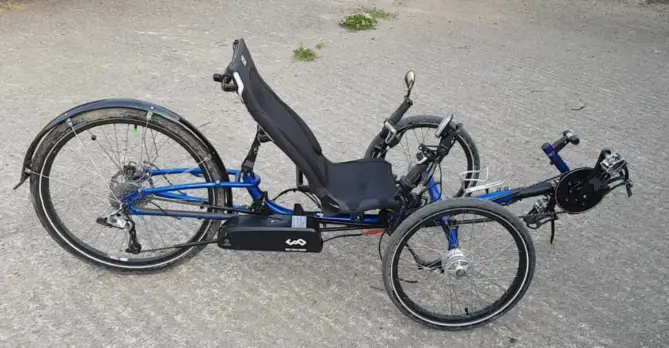
Most manufacturers now offer e-assist on their recumbent trikes and bikes, but these are comparatively expensive when compare with the DIY kit option. The Bosch, Yamaha and Shimano Steps units are renowned for their reliability over massive distances, but are nigh on impossible to repair should something go wrong. The TSDZ2 on the other hand can be fixed by any DIY enthusiast as the motor itself is easy enough to work on and spare parts are readily available.
>Check out Recumbent Trikes and Bikes on eBay<
The motor performance is, in my opinion on par with the Bosch Active Plus, it produces plenty of power, especially in ‘Turbo’ mode and is guaranteed to put a smile on your face.
Pedalling with the assist off and the extra weight and slight resistance of the motor becomes evident – not a problem on the flat, but if you run out of battery power with a long climb to tackle you could have some problems.
All in all, I’m giving this motor the thumbs up! It’s great value, it performs well and does the job. Links below on where to purchase this motor.
| Amazon |
| eBay |
| Aliexpress |
| Check the Latest Prices at ebikepricecomparison.com |
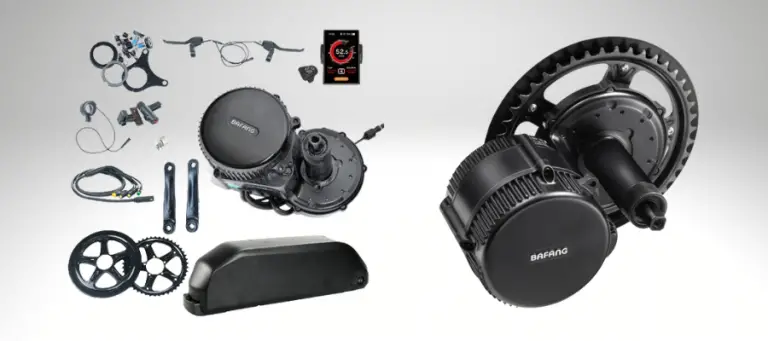
Bafang BBS01 / BBS02 / BBSHD
The Bafang mid-drive motor has been a market leader for over five years, and it continues to be the best-selling electric bike conversion kit in its class.
The motor itself is a great little unit, and for the most part seems fairly reliable. I used a Bafang BBS02 powered bike for a year, covering nearly 2000 miles without any problems whatsoever.
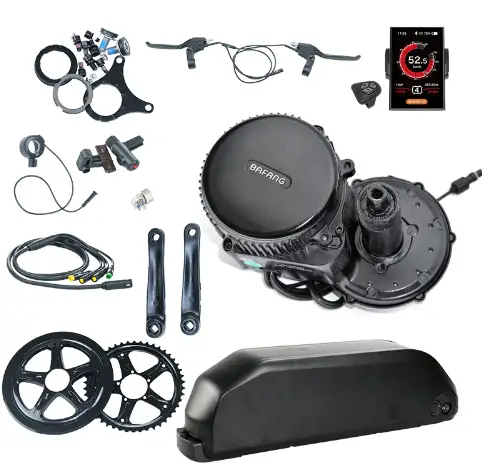
The Bafang motor is currently available in many different variants: BBS01B 36v 250w / 350w BBS02B 36v 500w, BBS02B 48v 500w / 750w, BBSHD 48v 1000w.
Which model you choose depends on the amount of power you need. As I have mentioned previously, you will need to carefully consider the law in your country.
The tables below show the peak power output of all the Bafang models (with a fully charged battery).
| Bafang Motor | Battery | Peak Power |
|---|---|---|
| BBS01B 250w | 36v (42.2v x 15A) | 633w |
| BBS01B 350w | 36v (42.2v x 18A) | 759w |
| Bafang Model | Battery | Peak Power (Watts) |
|---|---|---|
| BBS02 500w 36v | 36v (42.2v x 25A) | 1055w |
| BBS02 500w 48v | 48v (54.4v x 18A) | 864w |
| BBS02 500w 52v | 52v (58.8v x 18A) | 1058w |
| BBS02 750w 48v | 48v (54.4v x 25A) | 1200w |
| BBS02 750w 52v | 52v (58.8v x 25A) | 1470w |
| Bafang Motor | Battery | Peak Power |
|---|---|---|
| BBSHD | 48v (54.4v) x 30A | 1632w |
| BBSHD | 52v (58.8v) x 30A | 1764w |
It is worth noting that the peak power figures do not represent the nominal power output of these motors. The 250w motor for example can peak at over 600w briefly whilst under load, but the ‘keep current’ setting in the controller programming will ramp back the power once pedalling cadence increases.
In my opinion 250w provides adequate electric assistance, but if you are after some real power the BBSHD is on another level! If you were planning an off-road adventure then the BBSHD would be more than up to the job. I have ridden many bikes powered by this motor and the amount of torque it produces never ceases to put a smile on my face.
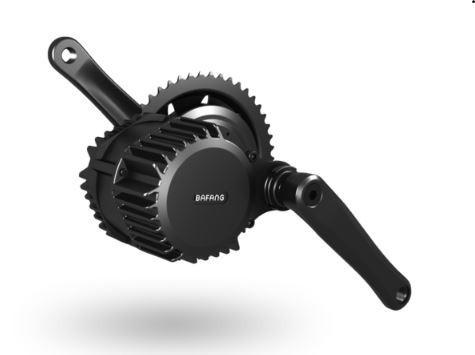
The ‘HD’ stands for heavy duty and I think the point of buying a BBSHD would be in the robust design of the motor. It is very heavy at nearly 5kg, but if you just wanted a super reliable drive unit that could be ridden day in and day out without a care in the world then this is a great bit of kit. And of course, you don’t have to ride it in full power mode. You have 9 power levels to choose from and level 1 is around the 250w mark, so you can still get a workout if you so desire.
The best all-rounder for me is the BBS02B, whether in 36v 500w or 48v 750w guise. Although it doesn’t produce the raw grunt of the HD, it still produces more power than most of us will ever need and it is a bit more affordable.
Buy the Bafang M625 from Amazon
Riding a Bafang-powered recumbent
Unlike the Tongsheng, the Bafang motor uses a much more simple cadence-based pedal assist, which acts like an on/off switch. The way the power ramps up once pedalling begins depends on the way the motor controller is configured, the rpm of the motor will also be limited by the controller settings.
One of the great features of the Bafang is that you can alter these settings easily using a laptop and USB programming lead and free open-source software – you can reprogram the motor to produce a very smooth and intuitive level of pedal assist. The best beginner’s guide to programming the Bafang can be found on Karls Electric bike blog.
Is the Bafang mid-drive motor suitable for a recumbent?
Like the TSDZ2, the Bafang motor wasn’t designed specifically for recumbents, but having installed a couple of recumbent bikes myself, it seems to do the job perfectly! It is heavier than the TSDZ2 at around 4kg (4.8kg for the BBSHD) and physically slightly larger.
The short video below shows a recent installation of a Bafang BBS01B 36v 250w onto an HP Velotechnik Grasshopper recumbent bike.
The main criteria for installation are the same as with the Tongsheng. The motor shaft will fit a standard 68mm BSA threaded bottom bracket shell. The one important consideration is to make sure that the motor is secured tightly so it does not pivot in the BB shell. The mounting plate provided by Bafang will go some way to prevent the motor from moving, but you will want to have a Bafang lockring spanner in your toolkit just in case you need to tighten the motor.
As with the Tongsheng, you will need to purchase an additional speed sensor extension cable as the standard cable will not reach the motor.
To mount the display, you will need something like the Minoura accessory mount (as used on the conversion above). Terracycle also does a mount specifically for recumbents.
As with any electric conversion, where you decide to mount your battery is important. You could go for a small compact bottle battery that would fit into a bottle cage or bag or you could go for a more elegant solution like the Terracycle battery mounting kit as mentioned in the Tongsheng section.
>Check out Recumbent Trikes and Bikes on eBay<
Is the Bafang motor reliable?
Bafang has been the market leader in DIY mid-drive e-bike conversion kits since 2014, and, like Tongsheng were plagued by early reliability issues – these mainly stemmed from poor quality MOSFETs in the motor controller.
These issues have been resolved, although as with any electric bike motor there are still long-term reliability concerns to think about. I have listed below the main problem areas I have encountered with the Bafang mid-drive:
- Electrical problems – particularly controller failure on the BBS02 48v 750w. This is less of a problem on the BBSHD and the 36v models.
- Not 100% waterproof, do not use a pressure washer or fully submerge – persistent riding in heavy rain, can on occasion cause problems.
- Primary nylon gear wearing out – this seems less of a problem than on the TSDZ2
- Hall sensors – sometimes a bad solder, or poor connection at the controller
- Pedal assist sensors can sometimes fail (although this seems quite rare).
It should be noted, that in my personal experience I have installed well over 100 Bafang mid-drives in the last three years, and I have had one 250w motor fail (after 14 months and 2000 miles), one controller failure on a 36v 500w, three controller failures, and one hall sensor failure on the BBSHD and eight BBS02 48v 750w controller failures. All the controller failures on the 750w version happened on bikes with 52v batteries fitted.
Conclusion
Despite the above problems, I still think the Bafang is a good motor. The BBS01B 250w will provide enough assistance for most riders, and if you fancy having a bit more power on tap for those steep climbs the BBS02 is excellent. The BBSHD is a very strong and efficient motor and gives you the flexibility of power ranging from 250w up to a potential 1700w. I wouldn’t personally install a BBSHD on a recumbent bike for myself, as I think having all that power available would be too tempting to use and I like to get a decent workout when I go riding.
Which mid-drive motor is best for a recumbent trike or bike?
This boils down to your preferences. For me, the TSDZ2 wins hands down, as it provides an enhanced riding experience and is a very neat installation. The Tongsheng provides a very fluid and intuitive pedal assist. The Bafang is also great and you have the added benefit of being able to easily configure the controller settings to suit your needs.
A lot of very experienced recumbent riders agree with my verdict on the Tongsheng, the following testimony is from one of my readers: Glen from Vancouver Island, Canada. Visit Glen’s website: mid-islandadventures.com – There is a wealth of information on his site for recumbent riders.
For those that are interested, I have just taken off my Bafang 36 volt/350-watt Mid Drive from my HP Gekko & replaced it with the TSDZ2 36 volt unit. I have had this TSDZ2 unit sitting in my shop for several months as it had been returned to me in need of repair. Since I had some free time on my hands I decided to open up the Tongsheng to see if I could figure out what was wrong. Since I had previously serviced this unit with new grease, and new Brass primary Gear, I suspected I had missed something or there was something faulty in the unit. It turns out a loose screw at one of the phase wire terminals had come loose & had been sparking inside the motor cover. Some emery cloth for cleaning up the Brass Terminals, a new screw, some Blue Loctite and a little JB Weld & that motor seems to be running well now,
As I had spent some time with the Bafang on my Gekko, I should be able to make a direct comparison between the two comparably powered motors. Same Trike, the same riding conditions, the same battery & weight & the same rider.
So here goes – Since my trike is equipped with an Alfine 11 speed out back my ride results may differ slightly from those with a cassette & derailleur.
The first big difference is in the smoothness of the power delivery. The TSDZ2 feels more like stepping on a Gas Pedal whereas the Bafang unit feels more like turning on a light switch. The Power is either ON or OFF.
Both units seem acceptably quiet in use & being on a Trike Boom right out in front of you may be something to consider. This is a TSDZ2 with the Brass Gear upgrade as well which some owners have reported as being noisy. I didn’t find it so but I do tend to either grease or oil anything that moves to be on the safe side. Coming from a Chinese factory I would recommend everyone to take off your covers before they have installed your motor kit of any brand & give it a going over. 12-hour shifts 7 days a week can mean some units just don’t get the final love & care they should.
One of my gripes with the Bafang is the time delay from when you stop pedalling & the motor finally stops applying power. In practice, this may only be 5 secs but when you stop pedalling to shift gears on an Internal Gear Hub it can feel like 10 secs between shifts. During that time you get the motor trying to bypass the braking or clutch on the IGH resulting in some added noise. With the TSDZ2 unit, the Power stops as soon as you stop pedalling. This can of course be eliminated with the use of gearshift sensors on the Bafang but NOT having to add even more cables or possible problem connections to the TSDZ2 is just another bonus.
Both units come with an LCD Control that seems pretty similar in function & information displayed. The Bafang unit seemed to be a nicer quality than the T unit but the T unit was more adjustable having a nice tilt feature should you be getting glare or the sun reflecting in your eyes. Another plus for the T unit is its lightweight & compact size weighing about 2 lbs less than the Bafang. It also installs without doing any damage to the Bottom Bracket Shell which does result in indentations from the locking ring with the Bafang.
So which is the better unit? For me, it would still be a Geared Hub Motor as my first choice since the Power is more direct to the road & not lose efficiency through your chain, back gears & then finally to the road. If I had to choose between the Bafang & The TSDZ2 it would be the TSDZ2 with 500 watts.
Screenshot of Mid-Island Adventures – click on the photo to be taken to the website.

Electric Rear Hub Motor Conversion Kit
A geared hub motor is one of the easiest ways to add electric assist to your recumbent. Not only are these motors very reliable, but there is no increase in pedalling resistance with the assist switched off (unlike the TSDZ2 and Bafang BBS).
Hub motors are also generally cheaper than mid-drives, plus you don’t need to lose your front crankset. Below is a video of an Ice Trike fitted with e-assist using a Bafang 36v 250w rear hub motor conversion kit.
Will a rear hub motor fit my recumbent?
This depends on several factors. If you have an internally geared rear hub like a Shimano Alfine or Rohloff then the answer would be no, unless you were willing to revert to derailleur gears.
The other thing to consider is the size of your rear wheel and the width of your dropouts. Most hub motor kits are available in 20″ / 26″ / 28″ wheel sizes but are nearly always made to fit the standard bicycle dropout width of 135mm. A slight variation on this should not pose too much of a problem, but if your rear dropout is substantially narrower, you would need to think about a crank motor. If you do not know the width of your rear dropout, remove your rear wheel and take the measurement using a tape measure of Vernier calliper.
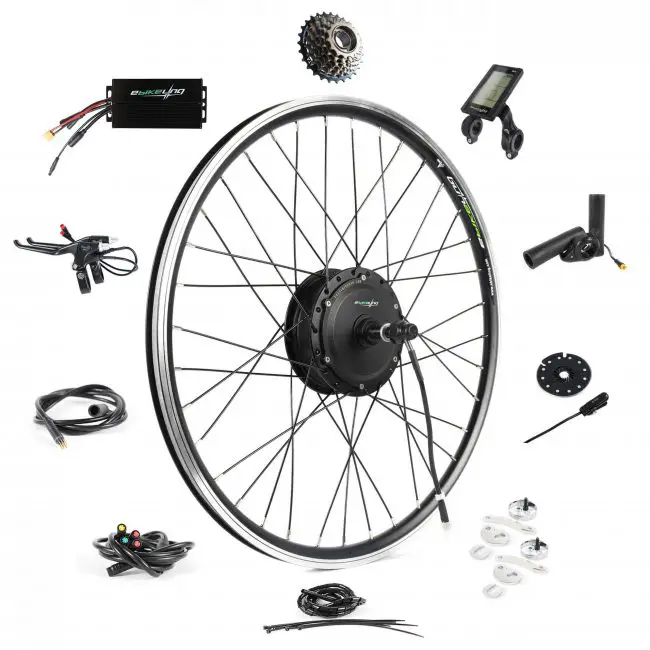
✅The Ebikeling 500w 36v 26″ rear wheel conversion kit (US shipping)[/caption]
Pedal sensor compatibility can be an issue. Most of these kits come as standard for fitting on the right-hand side of a square tapered sealed cartridge bottom bracket. If you have a Hollowtech II, SRAM GPX or BB30 Pressfit bottom bracket you will need to order a compatible pedal sensor.
It is also likely that you may need to extend the cable going from the pedal sensor on the crank to the controller box/bag.
The Benefits of fitting an electric hub motor to a recumbent
- Ease of installation – you just need to swap out your rear wheel and fit the pedal sensor, battery, motor controller and display.
- Cost – hub motor conversion kits are nearly always cheaper
- Simplicity – If hub motors do go wrong (which is quite rare) they are easy and cheap to repair or replace.
- If you use derailleur gears you get to keep your full range of gears – e.g. triple on front 8/9 speed at the rear.
Negatives to fitting a rear hub motor
- Rear hub motors do not produce as much torque as crank motors (40Nm vs 80Nm).
- Repairing rear wheel punctures can be time-consuming – fit Schwalbe Marathon Plus tyres.
- Not compatible with all recumbent dropouts
- Hub motors are not as efficient as crank motors – reduced battery range.
Riding a recumbent fitted with a rear hub motor
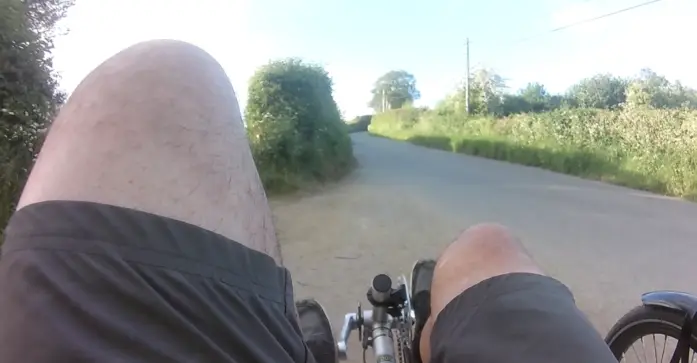
I have installed a couple of Bafang rear hub motors on a recumbent bike and trike and I think they work great. Indeed, they don’t produce the torque you get with a crank motor, but the assist is more than adequate in my opinion. I live at the bottom of a 0.2 miles 8-10% hill and my personal best on my road bike (unassisted) is 1 min 20 secs, on a 250w Bafang powered Ice Trike I did the same climb in 1 min 13 secs, and that was without getting too out of breath!
Most of the rear hub motor kits available use the cadence-based pedal assist, much like the Bafang mid-drive motor. There are hub drive systems available which use a torque sensing pedal assist to produce a smoother more efficient level of assistance much like the Tongsheng motor.
The main issue with fitting a torque-sensing hub motor kit is you will need to remove your existing bottom bracket to replace it with the torque-sensing one. You will also need to drill a hole in your bottom bracket shell to thread through the connector lead to the controller – you must fit a rubber grommet into this hole beforehand because if you don’t it is very likely you will damage the connector lead when threading through the hole. You will also need to get a compatible extension lead for the torque sensor connector as the one supplied with the kit is not long enough for a recumbent.
Conclusion
The age-old question of is a hub motor better than a mid-drive or visa-versa boils down to your expectations of what you want from electric assist. Personally, I think hub motors are great, they lack the torque and efficiency of a crank motor, but they still do the job of providing electric assistance very well. The other plus point is the lack of drag at the wheel (and crank) when pedalling with the assist switched off.
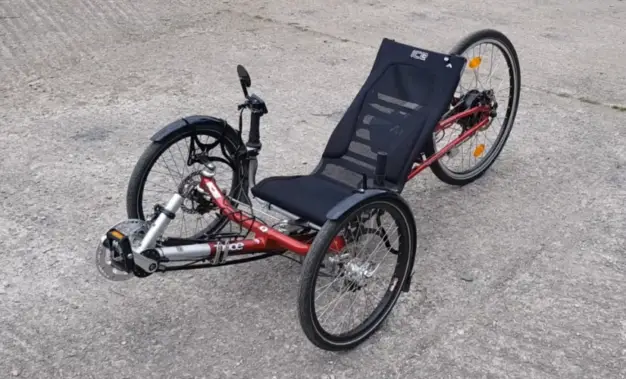
The main selling point of any hub motor would be its long-term reliability. I have installed a lot of geared hub motors over the last three years, and I haven’t had one single reported motor or controller failure. I have had some minor problems like pedal assist sensors playing up and occasional issues with the display. But apart from that, the motors themselves are excellent.
I wouldn’t hesitate to take a hub motor-powered recumbent on a 1000-mile tour!
Links to rear hub motor kits
Buy the Ebikeling 500w 36v 26″ rear wheel conversion kit (20″ also available)
| Amazon |
| eBay |
| Aliexpress |
| Compare the Latest Prices on ebikepricecomparison.com |
Thanks for reading, if you have any questions, please feel free to leave a comment below. I usually reply within 24hrs.

I have a TerraTrike Maverick. I would like to add an electric assist. Does anyone have experience with this trike? Which electric assist kit do you recommend?
Hi John,
The most straightforward conversion would be an 500w ebikeling 20″ rear wheel hub motor conversion kit. The only modification you might to do is extend the pedal assist sensor cable (which will run from the crank to the motor controller). If you mount the controller as centrally as possible, preferably under the seat all the other cables should reach. For the battery you could use a TerraCycle battery mount. For a decent battery, I’d go for a Unit Pack Power 36v 20Ah, I’ve purchased over 100 batteries from this company and found them to be very reliable.
I hope this helps, if you have any more questions, please let me know.
Cheers,
Tony
Tony,
Thanks. However, when I look at an image of the ebiking conversion kit on the Internet, I see an external chain gear with seven gears. My current TerraTrike has a Shimano Nexus internal transmission, with just one chain gear on the outside. If I use the ebiking conversion kit would I use my old external gear, or would I use the multi-gear shown in the ebiking site? https://ebikeling.com/products/500w-ebike-conversion-kits
John
Hi John,
If your bike has the Nexus geared hub it would rule out a rear hub motor, unless you were happy to change to a derailleur set-up. I reckon a crank motor might be a better bet, and you’d get to keep the Nexus gearing. I’ve installed Bafang and Tongsheng mid-drive motors on similar trikes – both can have their gremlins, but the Tongsheng motor is better suited to recumbents in my opinion. You’ll need to remove the crank and bottom bracket for the installation, but the end result will be a much more efficient e-assist system. The TSDZ2 is available from Eco Cycles, and they have a lot of experience fitting them to recumbents, so they should be able to help you with the conversion.
All the best,
Tony
Am I correct that the 500w ebikeling 20″ rear wheel hub motor conversion kit will not work with the internal gear hub that is on my TerraTrike Maverick?
Yes, because you would need to completely swap out your existing rear wheel with the electric one. The only way to retain your internal gears would be to fit a crank motor or front hub motor.
Hi Tony,
Thank you so much for all the time and kindness you’ve put into sharing such helpful information on these topics with folks.
Do you happen to have a front hub motor that you might recommend for a recumbent? (specifically an HP Grasshopper FX?) It seems like the front-hub approach might have some advantages, especially when looking for the best reliability, and dealing with an older SRAM dual-drive.
Is there a way to get good functionality out of a hub motor without having to replace the bottom bracket? If not, how is the quality on the threaded bottom brackets in kits like these?
Would you recommend getting a set of metal planetary gears for a hub motor, and keeping them on hand? Technology moves fast, and I’m wondering if there might not be properly sized replacements options on the market, by the time the original nylon gears wear our.
Many thanks for your time and kindness,
Drew
Hi Drew,
I’m not sure of the width between the front dropout on the HP Grasshopper, but if it’s a standard size then a regular 20″ front hub motor should fit. Regarding the torque-sensing bottom bracket, it would be worth having a chat with ebikes.ca – they supply a wide range of high quality torque-sensing BB’s along with complete kits. They would also be able to supply additional parts – It’s always useful to have a spare gear set just in case, although I haven’t had one fail (on a customers bike) in 4 years.
I hope this helps, if you have any more questions, please let me know.
Cheers,
Tony
Tony,
?. Where did you find the mirror clamp that clamps on to the minoura
Hi John,
It’s been a while since I did that conversion. If my memory serves me correct, the mirror just clamped on to the Minoura mount with the aid of a couple of rubber shims.
I’m looking for 250w hub motor in a 20 inch wheel for my Azub trike…ideally sent from the UK or at least Europe. Somehow this seems hard to find, with 26inch usually being the smallest for a rear hub. If you have any pointers I’d be grateful.
Cheers
Hi Duncan,
Your best bet would be to buy a 26″ wheel conversion kit and have the motor laced into a 20″ rim. There’s plenty of 20″ front motor kits available, but rear wheel kits are harder to come by. If you have a good local bike shop, they should be happy to do the job – my LBS charges around £60 including rim and spokes. I would imagine the guys at Swytch would do a 20″ rear wheel conversion, but their batteries are quite small. Dillenger UK also spec a 20″ rear hub motor kit, but the power output exceeds the UK legal limit.
If you don’t mind paying the import duty, it might be worth trying Aliexpress – although it seems most of the suppliers who have EU fulfilment warehouses won’t ship to the UK. The only other option is to buy direct from China – Here is a link to a trusted vendor I’ve used in the past (20″ rear hub motor kit 250w).
Let me know if you have any more questions.
All the best,
Tony
Tony:
I have been using a 750W 52V TSDZ2 for three years now (10k + miles), first on my 2005 LoGo and then on my ICE Adventure HD fs 20. I have lost two metal (blue gear) replacements in that time; the first one was failure of the one way clutch/bearing installed in the gear and the second one was due to my poor installation resulting in damaged teeth on the brass gear (no damage to the motor gear). I have also experienced problems with the VLCD5 display, all of my problems were failure of the electrical connections between the display and the mounting bracket, I have since gone to the minimal display from ECO Cycles and had no problems since I installed it as there are no connecting pins in the circuit. I have also experienced more than one torque sensor failure but have found that it is fairly easy to replace and as it is a fairly easy problem to recognize and fix I normally have a spare unit sitting in my tool box so that I don’t have to waste time waiting for parts. One failure I did experience was the failure of the P clamp provided when I bought my kit. I found that a similar item was available (in multiple sizes) for chain link fencing. I had to use a different size when I went to my ICE but have had zero failures of this heavier part. I found that mounting a battery on the rear rack can be problematic in some cases. On my LoGo I had a Topeak rack which worked great for mounting the battery, however when I switched to my ICE the Topeak rack could not be mounted due to the suspension and the ICE rack was not built to have the battery weight that high. The result was failure of the rack and the result was that I had to go to a ICE battery mount for suspended trike with rack option.
I have found that about the only special tools required for installation/maintenance are a bottom bracket removal tool (specific to your bottom bracket), a crank arm puller, and snap ring pliers. All other tools (metric wrenches) are probably found in your tool box already.
In my career prior to retirement I provided direct fleet support in the repair/maintenance of Fire Control Radar systems plus generation of maintenance procedures and documentation. With that experience I have documented (maintenance/repair procedures) for my TSDZ2. I have procedures for the following:
1. TSDZ2 Lubrication
2. Torque Sensor Replacement
3. Blue/Metal Gear Replacement
I’m currently in the process of procedures for main motor replacement and controller replacement along with a generic installation procedure. If you are interested in copies e-mail me and I’ll shoot you a copy in either word or .pdf.
Hi Bruce,
Thanks for sharing this information, much appreciated. I’ll send you over an email for the pdf file.
All the best,
Tony
Hello Tony,
I read your comparisons of conversion kits. I have a Greenspeed Magnum Recumbent bike with 27 speeds. I want the Bafang Rear-wheel cassette Kit for a 20″ wheel with the 48V12AH battery. The Bafang Kit model looks to be the Sw102. My first question is: which battery should I get? I am leaning toward the Shark battery with the Fully Configurable Battery Mount (For Most Bikes & Trikes). That leads me to my second question: which battery shelf should I get? The Standard Shelf or the Adapter Shelf (fits rear rack and large batteries). My next question concerns the brake level or brake sensor for hydraulic brake levers. My rear wheel doesn’t have any brakes. Both brake levers are attached to the two front wheels. How would braking work with the electric motor engaged in that case? I believe the battery choice I selected will work because I do not need it to add range or speed. I need the motor to add uphill push assistance because I have reduced lung capacity due to lung surgery and physical disability. My legs are strong, but they need help on hills. Thank you in advance for any advice or pointers.
Hi Blake,
The Shark battery with adapter shelf should do the job (if you already have a rack fitted). You could get the rack-specific battery (with rack), but looking at the Greenspeed rack, it looks like it’s made to fit that trike. The hydraulic brake cut-off sensors will work regardless of brake arrangement – they aren’t the best solution and can be awkward to fit properly depending on the shape on your levers. I usually only fit these sensors if a throttle is also being used. If it’s just going to be for pedal assist, I wouldn’t normally fit them.
If you’re not relying on the assist all the time, then a 12Ah battery will be fine – the battery and motor kit will add around 8kg to the total weight of your trike, but the motor doesn’t drag when the assist isn’t used.
I hope this helps, let me know if you have any more questions.
Cheers,
Tony
Hello Tony,
When you say Greenspeed rack, is that a specific rack that I can order or that comes with a kit?
Thanks,
Blake
Hi Blake,
It’s the luggage rack that Greenspeed sell as an accessory (on their website). I thought it might be the best mounting solution as it’s specifically made to fit your trike. You would still need to have a suitable battery mounting plate to fit to the rack. I’m not 100% if the battery rack supplied with the kit would be compatible due to the design of the trike, but I’ve fitted similar racks to Ice Trikes in the past, so it might work.
Regards,
Tony
What an impressive knowledge about DIY conversions. I’ve been considering adding an electric assist to our two older TT recumbents (TT Tour and TT Tandem Pro). I’ve spoken with TT techs here in West Michigan and they didn’t see any options in the near future for adding the motors to older models, especially the Tandem Pro.
My spouse has had some health issues and so the priority has been to find an appropriate kit for her TT Tour. One manufacturer and a TT local dealer are recommending the hub rear wheel type. Given the discussion here with many others, it looks like that’s probably adequate for our riding which is primarily on paved rail-to-trail bike / run / walk paths with slight slopes.
The question then is which manufacturer and model makes the most sense and has the best reliability. I’ve heard mixed comments about Bafang and from Vancouver BC eBike. And I’m feeling a bit challenged by the installation process, given my elementary electronics knowledge though I’ve done a fair amount of long distance bicycling and can pretty much repair anything on a traditional multi-speed derailleur equipped bike.
What would you suggest?
Hi Ken,
Looking at the specs of both the TerraTrike models you have, I reckon a rear hub motor would definitely be the way to go. I haven’t personally experienced any major issues with the Bafang hub motor, despite loads of conversions over the years. You might need to extend the pedal assist sensor cable, battery lead and motor cable – you may not need to do this on the TT tour, but I reckon you’ll definitely need to do it on the tandem – here is a link the extension cables.
On the tandem I’d fit the sensor to the front crank if possible and mount the controller box centrally. Assuming that both bikes have standard square-tapered bottom brackets then the regular pedal sensor supplied with the kit should fit.
Depending on your rear derailleur arrangement, you’ll need to get a motor that has a cassette freehub as some of the motor kits only support the screw-on freewheel type (although you can buy 8-speed freewheels if required).
Looking at the specs of both TT bikes, they have 20″ rear wheels, so it should be easy enough to find a suitable conversion kit – here are some links below.
Ebikeling 36v 500w 20″ rear hub motor kit (freewheel gears only) – I’ve heard good things about this kit and they are based in Illinois, so customer support should be good.
Bafang 48v 500w rear hub kit (cassette freehub option available) – Higher voltage + lower peak current will be better for reliability. I’ve installed lots of these over the years – generally very reliable although the planetary gears inside the motor may need replacing after many miles. These are easy to get hold of and it takes less than 30 mins to do the job. There’s a 750w option available as well.
As far as battery is concerned, I would go with something around 17.5Ah for a range of around 60 miles (more if low power is used). If you need a much bigger range you can buy a spare battery or purchase something like a 30Ah battery which should give an easy range well in excess of 100 miles.
TerraCycle sell an e-bike battery mount specifically for recumbent trikes, although you can always go with a rack-mounted battery.
I hope this info helps, if you need any more advice, please let me know.
Cheers,
Tony
have you had any exp. w/ a Dillenger Premium offroad bike kit. wanting to install on an Ice 26x. The motor is made by Befang for Dillenger. thanks Dameon
I’ve had a few kits off Dillenger in past and they’ve always been decent enough. I haven’t had any experience with this particular kit but it looks like a regular Bafang hub motor laced into a 26″ wheel so it should fit an Ice Trike. One thing to check though is if the motor has fitment for a gear freewheel or cassette freehub (for the rear gears). The Ice Trike usually has an 8 or 9 speed cassette fitted, so if the motor has a threaded freewheel fitment you’ll also need to buy 8 or 9-speed freewheel.
Regards,
Tony
Hi Tony, I bought a 2014 HPV Gekko (20″ rigid frame) a few years ago. It came with a Nuvinci 360 hub. I’m 79 yo and at the point where I need pedal assist. Can you give me a little guidance?
Thanks
Hi Bill,
Your best bet would be something like a 48v 500w Tongsheng TSDZ2 crank motor. Battery size will depend on how far you intend riding in between charges – a 48v 17.5Ah battery would give you a potential range of around 60-70 miles depending on how much assist you use and how hilly the terrain is. Here is a link to the full kit including battery on eBay. You will also need a steel P-clip collar for the boom, so you can fix a short 8mm bolt into the motor to prevent it from pivoting in the bottom bracket shell – the boom diameter on an Ice trike is 38mm, so I’m assuming the HPV is going to be similar.
You will also need a speed sensor extension cable and possibly a Terracycle Battery mount or you could have one fabricated if you know a good engineer. You will also need to consider an accessory mount (for the end of your handlebar to mount the display).
It’s worth having a chat with Glen at Mid-Island Adventures – he’s based up in Vancouver Island and has lots of experience converting trikes using the TSDZ2, he also has lots of spare parts available including the speeds sensor extension cable. Here is a link to his website.
I hope this helps, if you need any more info, let me know.
Cheers,
Tony
Hi
I tried the Catrike dumont in the Veterans Administration in Palo Alto. I think they will provide for free since Im a disabled veteran. I just need pedal assist mostly riding in paved bike lanes or pedestrian walks. I also need a way that if I get tired to get back home. something reasonably priced since I have to pay for the upgrade.
I thank you for any advise or thoughts so I know when I go pick one in the bike store
Regards
Ariel
Hi Ariel,
I’ve looked at the Catrike Dumont and I reckon the Bafang BBS02B 750w would be a great option. With the 48v 17.5Ah battery you should get a range of anywhere between 50-80 miles depending on how much assist you use. There are 9 levels of assist to choose from and the motor can also be fine-tuned using the optional USB programming lead and free software. The mechanic who does the installation may need to fabricate a stabiliser bar to secure the motor and stop it from rotating in the bottom bracket shell.
Here is a link to the kit you need from a reputable seller on Amazon.com.
If you have any more questions, please let me know.
Regards,
Tony
Hi Tony,
Just to let you know, that as a result of your super-helpful suggestions, I have succesfully fitted a Bafang BBSHD to my Ice Sprint, and it is close to magic how it works – I could not be more pleased 🙂 I have made a couple of small changes to the usual setup. Mainly because I could not source a metal P-bracket the right size, I have mounted the motor on top of the front tube, and it touches the tube that had been used to mount the front derallieur – with a small bit of padding inserted. It is a bit more conspicous I guess, but that does not bother me and it is less likely to get clouted by anything in the road.
I requested the sensors for the hydraulic brakes, but I could not find a reasonable way to mount them on the brake levers. I did receive the two standard cable brake levers, so I took one of them, removed the small internal fixture that holds the cable, and have mounted this on the left handle bar, and use it effectively as a clutch. I have it located where I can pull just that lever, or can pull it together with the left brake lever. I can easily use it to disengage the motor when necessary for changing gear, or indeed when starting in a busy location when I want to use my own power, rather than the sudden acceleration of the motor. It works really well.
I can send you photos of both things if you wish. Thanks again for your help and for sharing your knowledge.
Cheers, John
Hi John,
Glad to have been of help. I’d love to see some photo’s, I could add them to this article. My email address is cycletek@outlook.com.
Cheers,
Tony